

For Vancouver homeowners, deciding whether to replace a natural lawn with Artificial Grass is about much more than appearance. It can be a practical response to ongoing mowing, watering, muddy conditions, pet use and the time required to keep natural turf looking its best. However, the upfront Artificial Grass Cost Vancouver homeowners face can be substantial, so the important question is whether the investment makes sense for your property and lifestyle. This Artificial Grass Cost Guide explores installation considerations, long-term savings, water conservation, maintenance and the situations where synthetic turf can be a practical landscaping choice.
Artificial grass has evolved considerably from the stiff, plastic-looking products associated with older installations. Modern Synthetic Turf is available in different blade lengths, densities, textures, colours, backing systems and infill options. Higher-quality products are designed to create a more natural appearance while providing a consistent surface throughout changing weather conditions.
For Vancouver properties, artificial grass can offer some practical advantages. Wet weather can leave natural lawns muddy, soft and difficult to use, while periods of dry weather can create additional watering requirements. Homeowners who want a consistently green surface without regular mowing or routine lawn irrigation may therefore consider synthetic turf as an alternative.
However, artificial grass is not automatically the best option for every property. Natural grass has environmental and aesthetic benefits and can be suitable for homeowners who enjoy gardening and regular lawn care. Synthetic turf should be viewed as an alternative landscaping surface with its own benefits, limitations and maintenance requirements.
The right decision depends on how the space is used, the property’s drainage, available sunlight, household requirements and the homeowner’s expectations for maintenance.
When researching Artificial Grass Cost Vancouver, homeowners often focus on the price of the turf itself. This can create an incomplete picture because professional installation involves considerably more than laying synthetic grass over an existing lawn.
A complete project may include removing existing grass, excavating unsuitable material, preparing the ground, installing and compacting an aggregate base, addressing drainage, installing a weed barrier, cutting and joining the turf, securing edges and applying appropriate infill.
The overall investment can vary significantly between properties. A straightforward backyard with easy access and stable ground conditions may require less preparation than a site with poor drainage, difficult access, uneven terrain or extensive excavation.
For this reason, homeowners should request a detailed, property-specific quotation rather than relying solely on a general advertised price. A professional assessment provides a clearer understanding of the work involved and helps prevent unexpected expenses later in the project.
Several factors can influence the overall investment in artificial turf. Existing lawn removal is one consideration because old vegetation and unsuitable soil may need to be excavated and disposed of properly. Ground preparation can also become more involved if the existing surface is uneven or unstable.
Drainage is another important consideration for Vancouver properties. If water does not move efficiently through the existing ground, additional preparation may be necessary. Restricted backyard access can also increase labour requirements because materials may need to be moved manually through narrow passages or around structures.
The shape of the lawn can influence installation complexity as well. Curved borders, garden beds, trees, pathways and multiple joining points require more detailed cutting and positioning. Homeowners should also consider the quality, density and construction of the turf because different products can have significantly different characteristics.
A good quotation should explain the complete scope of work rather than presenting an attractive price without clarifying what is included.
The performance of artificial grass depends heavily on the surface beneath it. Artificial Grass Installation Vancouver projects should therefore focus on proper site preparation rather than simply placing turf over an existing lawn.
Experienced installers understand that shortcuts during preparation can create problems later. Organic material left underneath may settle or deteriorate, creating uneven areas. An inadequately prepared base can result in movement, dips or an uneven finished surface. Poor drainage can cause water to remain beneath the turf or around the edges.
Installation methods vary according to the property, but a professional project typically begins with the removal of existing vegetation and unsuitable material. The area is then excavated and graded according to the requirements of the site.
A suitable aggregate base is subsequently installed and compacted to create a stable foundation. The artificial turf is then carefully measured, cut and positioned. Seams need to be joined correctly, and the edges should be secured so the finished surface remains stable.
These hidden construction stages explain why professional installation costs more than simply purchasing turf. The synthetic grass is the visible component, but the preparation underneath plays a major role in the durability, appearance and drainage performance of the completed lawn.
One of the strongest arguments for synthetic turf is its potential to reduce certain recurring Maintenance Costs over the long term.
A natural lawn can require mowing, edging, fertilising, weed management, watering, aeration, reseeding and occasional treatment. The exact requirements depend on the type of grass, property conditions, weather and the homeowner’s maintenance routine.
Synthetic turf removes several of these recurring tasks. There is no mowing schedule and the grass does not need routine irrigation to remain green. However, it would be inaccurate to describe artificial turf as completely maintenance-free.
Homeowners should therefore calculate Long-Term Savings by comparing the initial installation investment with the expected cost and effort of maintaining their natural lawn over the period they intend to remain in the property.
For someone who pays for regular professional lawn care, the potential savings may be more significant. For a homeowner who enjoys mowing and manages the lawn independently, the financial benefit may be less important than the convenience and time saved.
Water Conservation is another factor that may influence a Vancouver homeowner’s decision. Artificial turf does not require regular irrigation to maintain its green appearance, which can significantly reduce the water used specifically for lawn maintenance.
Vancouver has seasonal watering restrictions designed to manage water demand during periods when supplies are under greater pressure. The City of Vancouver explains that lawn watering restrictions can become more stringent as seasonal water demand increases, with higher restriction stages potentially prohibiting residential lawn watering. This makes water-efficient landscaping an important consideration for many property owners.
However, artificial turf is not the only way to reduce outdoor water consumption. Homeowners can also reduce lawn areas, select plants suited to local conditions, use mulch, improve soil quality and install efficient irrigation systems where appropriate.
A sensible landscaping decision should therefore consider the whole garden rather than focusing on one feature. Artificial grass can be one component of a broader water-conscious design.
One of the most common misconceptions about Synthetic Turf is that it requires absolutely no maintenance. In reality, it requires less routine lawn maintenance rather than no maintenance at all.
Leaves, branches, dirt and other debris can collect on the surface. Pet owners need to remove solid waste promptly and may need to rinse areas regularly. High-traffic sections can benefit from occasional brushing to help keep the fibres upright.
Weeds can also appear around edges or through poorly maintained areas. Although synthetic turf does not grow like natural grass, surrounding garden areas can still introduce organic material and weed growth.
The important difference is the type and frequency of maintenance. Homeowners no longer need to mow, reseed or routinely fertilise the surface. This can make synthetic turf particularly attractive for people who want a consistently neat lawn while reducing regular garden chores.
A practical maintenance routine should include removing leaves and debris, cleaning spills promptly and rinsing areas when required. Pet owners should clean animal waste regularly and follow the manufacturer’s recommendations for hygiene and odour control.
Heavy-use areas can be brushed periodically to redistribute fibres and maintain their appearance. Homeowners should also inspect edges and seams occasionally, particularly after periods of heavy use or significant weather.
Following the manufacturer’s cleaning instructions is important because different turf products can have different maintenance requirements. Avoiding unsuitable cleaning chemicals can help protect the fibres, backing and infill system.
The goal is not to eliminate maintenance completely. Instead, the objective is to replace intensive lawn care with a simpler maintenance routine.
The answer depends on the homeowner, the property and how the Backyard is used. Families with children may appreciate a consistent surface that does not become muddy after wet weather. Pet owners may find synthetic turf useful in areas where natural grass repeatedly becomes damaged through heavy activity.
Busy homeowners can also benefit from reduced lawn maintenance. Someone who travels regularly or has limited time for gardening may value a surface that does not require regular mowing or watering.
Artificial turf can also be useful in smaller urban yards where every area needs to serve a purpose. A carefully planned space can combine synthetic turf with paving, garden beds, trees, shrubs and seating areas.
However, homeowners who enjoy growing plants, maintaining natural soil or supporting a more natural garden ecosystem may prefer to retain natural grass or reduce the lawn area rather than replace it entirely.
The best Artificial Grass Cost Guide approach is to consider the investment from several different perspectives rather than focusing only on the initial expense.
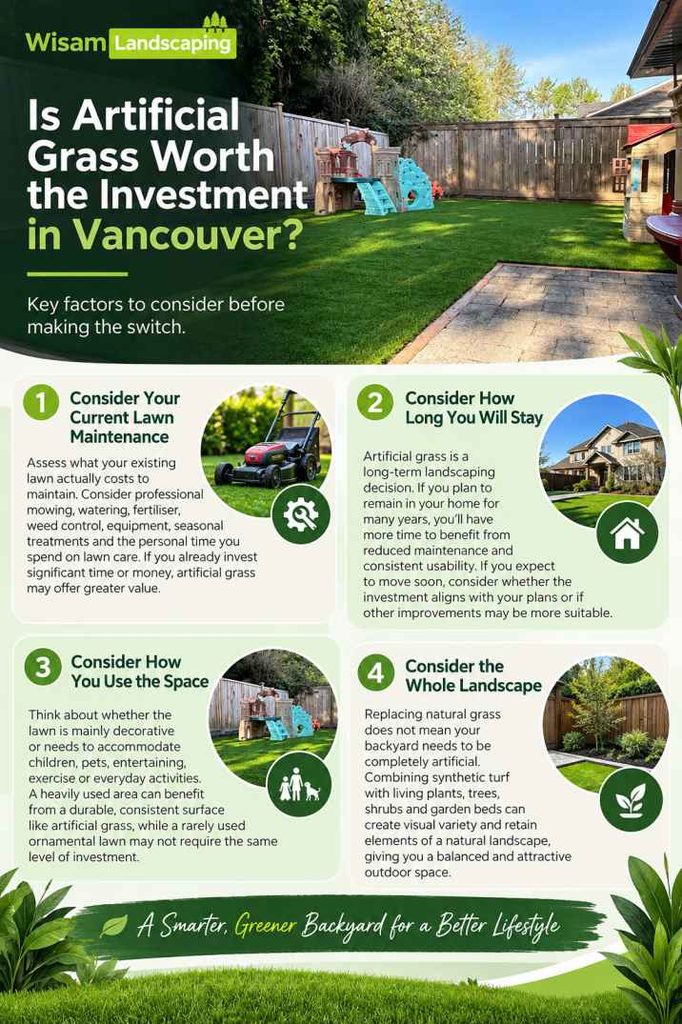
Begin by assessing what your existing lawn actually costs to maintain. Consider professional mowing, watering, fertiliser, weed control, equipment, seasonal treatments and other recurring requirements. Also consider how much personal time is spent maintaining the lawn.
A homeowner who already spends substantial time or money maintaining natural grass may see more value in synthetic turf than someone whose lawn requires very little attention.
Artificial grass is generally a long-term landscaping decision. If you expect to remain in your home for many years, there may be more opportunity to benefit from reduced maintenance and consistent usability.
Homeowners who expect to move relatively soon should consider whether the investment aligns with their plans and whether other landscaping improvements might provide greater practical value.
Think about whether the lawn is mainly decorative or whether it needs to accommodate children, pets, entertaining, exercise or everyday activities. A heavily used area may benefit more from a durable, consistent surface than a rarely used ornamental lawn.
Replacing natural grass does not mean the backyard needs to become completely artificial. Combining synthetic turf with living plants, trees, shrubs and garden beds can provide visual variety and retain elements of a natural landscape.
Good Landscaping design is rarely about using one material everywhere. Artificial grass can be incorporated into a broader garden plan that includes natural stone, timber, planting beds, pathways and outdoor seating.
For example, synthetic turf can provide an open central lawn while trees and shrubs create privacy around the perimeter. Paving can establish an outdoor dining area, while garden beds add seasonal colour and natural texture.
This approach can make the backyard feel more balanced. It also allows homeowners to reduce the amount of natural lawn without removing living vegetation from the entire property.
A well-planned backyard should respond to how people actually live. A family might need open space for children, while another household may prioritise entertaining, gardening or relaxing outdoors.
Artificial grass can provide a consistent base for flexible activities. When combined with appropriate hardscaping and planting, it can help create separate zones without making the property feel fragmented.
The most successful designs usually begin with the function of the space rather than the appearance of individual materials.
One common mistake is choosing turf solely because it looks attractive in a showroom. Appearance is important, but homeowners should also consider blade construction, density, backing, drainage, infill and expected traffic.
Another mistake is underestimating the importance of ground preparation. Simply installing turf over an unsuitable surface can increase the likelihood of settlement, unevenness and drainage problems.
Choosing an installer solely because they advertise the lowest price can also be risky. A cheaper quotation may exclude important preparation work or use materials that do not suit the property’s requirements.
Homeowners should also avoid assuming that every artificial turf product is appropriate for pets, children or high-traffic areas. Different applications require different performance characteristics.
Finally, do not overlook the rest of the landscape. A synthetic lawn can look out of place if it is installed without considering surrounding garden beds, pathways, fences, trees and outdoor living areas.
Before requesting an installation assessment, measure the approximate lawn area and take note of difficult access points. Narrow gates, stairs, fences and structures can influence how materials reach the backyard and how installation work is carried out.
Ask prospective installers for an itemised proposal. It should explain existing lawn removal, excavation, disposal, base preparation, drainage, turf, infill, edging, seams and labour.
It is also worth asking about the expected maintenance requirements. A reliable installer should be able to explain how the selected turf performs under your specific conditions and what routine care will be required.
Drainage should receive particular attention in Vancouver. Ask how water will move through the finished surface and whether the existing ground conditions require additional preparation.
Finally, request information about product warranties and workmanship guarantees. Understanding what is covered can provide useful protection and make it easier to compare different installation proposals.
Artificial turf is most likely to make sense when several practical needs overlap. These may include a desire for a consistently green surface, limited time for lawn maintenance, frequent lawn traffic, concerns about mud or an interest in reducing routine lawn irrigation.
Pet owners may find synthetic turf particularly useful where natural grass repeatedly develops worn or muddy sections. Families may also appreciate having a predictable outdoor surface that remains usable through different weather conditions.
For smaller properties, synthetic turf can provide an attractive, functional surface while leaving room for garden beds and other features. However, the decision should always consider the whole property rather than treating artificial grass as a universal replacement for natural landscaping.
No. The value of synthetic turf depends on individual circumstances. A homeowner who enjoys maintaining natural grass and already has an efficient, low-maintenance lawn may have little reason to replace it.
Likewise, homeowners who prioritise biodiversity, edible gardening or natural soil may prefer to dedicate more space to living plants. In these situations, reducing lawn area or introducing drought-tolerant planting may provide a better solution.
Artificial grass is most useful when it solves a specific problem. If the homeowner wants to reduce mowing, manage a high-traffic area, minimise lawn watering or create a more consistent outdoor surface, synthetic turf may be worth considering.
The important point is to make the decision based on practical needs rather than following a landscaping trend simply because it is popular.
For the right property, artificial grass can be a worthwhile long-term landscaping investment. It can reduce mowing, eliminate routine lawn irrigation, provide a consistently green appearance and create a practical surface for heavily used outdoor areas. However, homeowners should evaluate the decision based on the property’s conditions, expected maintenance, water requirements, installation quality and how the Backyard will actually be used.
The best decision is not necessarily to replace every natural lawn. Instead, consider where synthetic turf could genuinely improve the property’s functionality. Combining it with living plants, trees, garden beds, hardscaping and outdoor living areas can create a balanced landscape that is both attractive and practical.
For homeowners exploring synthetic turf as part of a broader landscaping plan, Wisam Landscaping can help assess how different landscape elements may work together. A thoughtful approach can consider the property’s layout, existing conditions, drainage, planting and intended use rather than treating artificial grass as an isolated feature.
When professional guidance is needed, Wisam Landscaping can also help homeowners evaluate practical options for integrating artificial turf with the wider landscape. The aim should be to create an outdoor environment that balances appearance, usability, maintenance and long-term value. Wisam Landscaping can be considered as part of that planning process when homeowners want their artificial lawn and surrounding landscaping to work together as one cohesive outdoor space.
Artificial grass requires a higher upfront investment than simply maintaining an established natural lawn because professional installation involves site preparation, base construction, materials, drainage considerations and skilled labour. The final amount varies according to lawn size, turf quality, ground conditions, access, drainage and installation complexity. The most reliable way to understand the investment is to request a detailed property-specific quotation rather than relying on a general advertised rate.
The lifespan of artificial grass depends on product quality, installation standards, foot traffic, exposure and maintenance. High-quality residential products can provide many years of service when properly installed and maintained. Areas exposed to heavy traffic, pets or constant use may experience more wear than lightly used sections. Homeowners should review the manufacturer’s warranty and ask the installer about expected performance for the specific product being recommended.
Yes. Artificial grass does not require routine irrigation to maintain its green appearance, so replacing a natural lawn can reduce water used specifically for lawn watering. This can be particularly relevant in Vancouver during periods when seasonal watering restrictions are introduced. However, synthetic turf is not the only water-conscious option. Reducing lawn coverage, selecting suitable plants, using mulch and improving irrigation efficiency can also contribute to lower outdoor water consumption.
Artificial grass can work well for dogs when the installation is designed with pet use in mind. Drainage, turf construction, infill and cleaning procedures are particularly important because pet areas need regular hygiene management. Solid waste should be removed promptly, and the surface may need regular rinsing. Homeowners with pets should specifically ask installers about drainage, odour control, cleaning requirements and the suitability of the proposed turf for animal use.
Professional installation generally requires proper preparation rather than simply placing turf over existing grass. Existing vegetation and unsuitable soil may need to be removed before the area is excavated, graded and prepared with a stable base. Proper preparation helps reduce the risk of settlement, uneven areas and drainage problems. The exact preparation method depends on existing ground conditions, access, soil composition and the intended use of the finished surface.