

Installing a new fence seems straightforward until you discover that the location, height, property boundary, permits, drainage, and even the relationship with your neighbour can affect the project. A fence can look perfectly positioned from the yard while actually crossing a legal boundary by several centimetres. For Vancouver homeowners, understanding the rules before digging post holes can prevent expensive changes and avoidable disputes.
This Fence Property Line Guide explains the practical considerations behind Fence Installation Vancouver, including property boundaries, local regulations, fence height, material choices, neighbour communication, and site preparation. The goal is not simply to build a fence that looks good, but to create a durable and compliant part of your residential landscaping.
The first step in any fencing project should be determining exactly where your property ends. A neighbour’s existing fence is not automatically proof of the legal Property Boundary. Older fences may have been installed in the wrong location, moved over time, or positioned for practical reasons rather than surveyed boundaries.
The City of Vancouver specifically advises property owners to contact a Registered BC Land Surveyor when they need to establish the location of a property line. The City does not provide private property surveying services or determine legal boundaries between neighbouring properties.
This distinction matters because a fence installed even slightly across the boundary can create complications later. For example, a homeowner might replace an old deteriorating fence and assume the existing post locations are correct. If the original fence was misplaced, reproducing its position could repeat the same problem.
A sensible property-line check involves more than looking at a title plan on a kitchen table. Start by gathering your available property documents and checking whether there are registered easements, statutory rights of way, or other restrictions affecting the property. The City notes that easements and statutory rights of way may be registered on a property’s title and can affect how land is used.
If the exact boundary is uncertain, a survey is the safest approach. This becomes particularly important when the proposed Fencing sits close to a neighbour’s land, follows an irregular lot line, or is being installed after landscaping changes have altered the appearance of the yard.
A few extra hours spent confirming the boundary can be considerably less expensive than removing posts, repairing landscaping, and rebuilding a fence after a disagreement.
Fence height is one of the most common areas where homeowners make assumptions. Vancouver’s requirements depend on where the fence is located, the property’s zoning, and the type of yard involved.
For a single detached home or duplex, the City currently states that a fence along the property line can generally be installed without a permit when it is 4 feet or less along the perimeter of the front yard and 6 feet or less along the side and rear yard.
The City’s zoning provisions also identify maximum fence heights in required yards, with different treatment for front yards and other areas. The zoning by-law states that height is measured from the ground level at the structure or fence line.
That measurement detail can become important on sloped properties. A homeowner may assume that a fence is a uniform height because the fence panels are identical, but changes in ground elevation can affect how the height is assessed.
It is risky to assume that every fence is exempt from permitting. The City identifies most new hard landscaping features, including fences and retaining walls, as work that may require a permit, while its fence-specific guidance identifies certain height and location conditions that do not require one.
If you want a fence above the standard permitted height, additional review may be necessary. Vancouver has a specific process for considering over-height fences, particularly in front yards.
Many homeowners searching for Privacy Fence Installation Vancouver are primarily focused on creating a taller barrier between neighbouring yards. However, privacy is not determined by height alone.
The position of the fence, spacing between boards, landscaping around it, changes in ground level, and the location of windows or outdoor living areas all influence how private a backyard actually feels.
A six-foot solid fence may provide excellent screening along one boundary but do little for privacy from a second-storey window. Conversely, a slightly more open fence combined with shrubs or carefully positioned planting can create a softer and more comfortable screening solution.
Privacy should therefore be considered as part of the overall Residential Fencing design rather than treated as a simple measurement.
A good privacy solution should also consider the person on the other side of the fence. A very tall, completely solid structure may feel oppressive when viewed from the neighbouring property, particularly if it blocks sunlight or changes the appearance of a small yard.
The City of Vancouver’s guidance for over-height front-yard fences emphasises maintaining visual openness toward the street and considering the relationship between private landscaping and the public realm.
For side and rear boundaries, the considerations are different, but good design still matters. Discussing the proposed fence with a neighbour before construction can identify practical concerns about access, drainage, tree roots, maintenance, and the exact location of the boundary.
Choosing the right material is not only an aesthetic decision. The material affects maintenance, durability, privacy, installation methods, wind exposure, and long-term appearance.
A Wood Fence remains popular because it offers a natural appearance and works well with many Vancouver residential landscapes. Wood can also be customised through different board arrangements, stains, finishes, and privacy configurations.
However, wood requires maintenance. Moisture, prolonged exposure to rain, poor drainage, soil contact, and inadequate sealing can contribute to premature deterioration. Posts are particularly important because a beautiful fence panel cannot compensate for posts installed in unstable or poorly drained ground.
A Vinyl Fence can appeal to homeowners looking for a relatively low-maintenance material. It does not require the same staining or painting routine as many wood products and can provide a consistent appearance over time.
However, material selection should account for the specific site. Wind exposure, installation quality, post support, temperature changes, and impact resistance all matter. A fence should be selected according to the property rather than simply choosing the material that looks best in a catalogue.
A Backyard is rarely a perfectly flat construction site. Vancouver properties can include slopes, mature trees, narrow side yards, retaining walls, drainage channels, patios, decks, gardens, and existing hardscaping.
These features can influence both fence positioning and construction.
For example, installing posts close to a mature tree may create root-related challenges. Digging without considering roots can damage the tree or make it difficult to achieve stable post installation. Similarly, placing a fence directly against a retaining wall may introduce additional height or structural considerations.
The ground condition should therefore be assessed before materials are ordered.
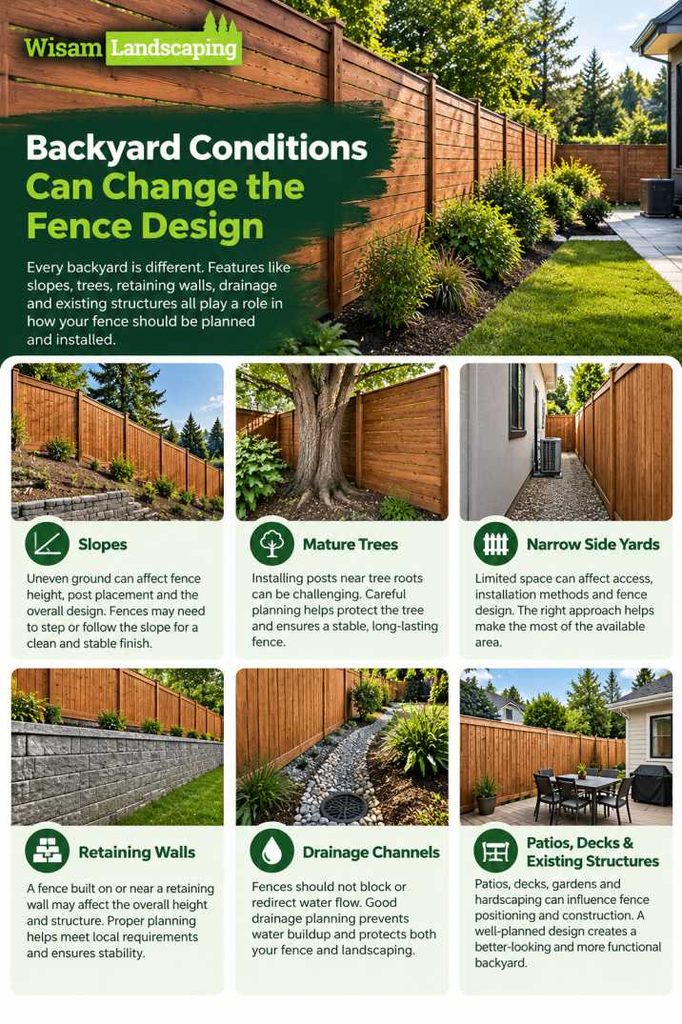
Water management is another commonly overlooked issue. A fence should not unintentionally redirect surface water toward a neighbour’s yard or create a location where water continually collects around posts.
On properties with noticeable grade changes, the fence may need to step gradually rather than follow the ground with large gaps underneath. The correct approach depends on the site, desired appearance, and practical requirements.
Existing paving should also be considered. Removing and reinstalling sections of a walkway or patio after the fence has been built can increase project costs. Good planning identifies these conflicts before installation begins.
There is a major difference between being legally entitled to install a fence and having a project that is easy to manage with neighbouring homeowners.
If the proposed fence sits directly on or near a shared boundary, discuss the project before construction. A neighbour may have concerns about access, appearance, drainage, maintenance, or the treatment of the finished side.
In some cases, homeowners may also choose to share costs or agree on a particular design. Any agreement involving ownership, payment responsibilities, maintenance, or future replacement should be documented clearly rather than relying solely on a verbal conversation.
Importantly, a disagreement over where the legal boundary sits should not be resolved by simply moving the fence until everyone is satisfied. Where the boundary itself is uncertain, professional surveying is the appropriate starting point.
This is one of the easiest mistakes to make. An existing fence can be a useful visual reference, but it does not establish legal ownership. Replacing it in exactly the same position without checking the boundary can carry an existing mistake into a new project.
On uneven ground, height can be misunderstood. Vancouver’s zoning provisions specify how fence height is measured from ground level at the fence line.
A fence that appears compliant from one side may require closer review when the site has significant grade changes.
The relationship between a fence and retaining wall can affect the permitted height. Vancouver’s zoning provisions specifically address fences installed above or close to common boundary retaining walls.
This is an excellent example of why a fence should be planned as part of the entire property rather than as an isolated structure.
Ordering panels before checking access, slopes, drainage, and post locations can lead to unnecessary waste. A professional site assessment should come before final material quantities and construction details are confirmed.
Experienced installers tend to focus on the details that homeowners do not always notice until construction begins.
First, confirm the boundary before excavation. This is particularly important where the fence will sit close to a neighbour’s property.
Second, check current Local Regulations. Vancouver’s requirements should be verified using current City information because zoning and permit procedures can change.
Third, plan for maintenance access. A fence should not make it impossible to clean, repair, paint, trim vegetation, or maintain structures on either side.
Fourth, consider the finished appearance from both sides. A fence is shared visually even when ownership is not shared. Consistent finishing and thoughtful construction can prevent unnecessary conflict.
Finally, solve the ground conditions first. Poor drainage, unstable soil, significant slopes, or existing structural issues should be addressed before the fence is installed. A strong fence depends on more than good panels; it depends on good site preparation.
Some fencing projects are straightforward, but others involve uncertain property lines, slopes, retaining walls, mature trees, easements, unusual zoning, or privacy requirements. These situations deserve more planning before construction begins.
The City of Vancouver recommends using a Registered BC Land Surveyor to establish a private property line when its location is uncertain. If the project involves unusual height requirements or a potentially complex permit situation, homeowners should also confirm requirements with the City before proceeding.
For the installation itself, an experienced landscaping professional can help identify practical issues such as access, grading, post placement, material suitability, and how the finished fence will work with the existing yard.
A successful fence project is about much more than selecting attractive panels. The Fence Property Line Guide approach is to start with the legal boundary, understand applicable Local Regulations, confirm Fence Height requirements, evaluate the site, and then choose a material and design that suits the property.
For homeowners planning Privacy Fence Installation Vancouver, the best outcome is one that provides the desired privacy without creating avoidable problems with property boundaries, drainage, neighbours, or municipal requirements. Taking time to plan before construction can make the installation smoother and the finished fence more useful for years.
When homeowners need practical assistance evaluating the site and planning the installation, Wisam Landscaping can help consider the fence design alongside existing landscaping, access, grading, and backyard use. The priority should always be a properly planned project rather than simply installing a fence as quickly as possible.
For homeowners comparing fencing options and preparing for construction, Wisam Landscaping can also provide practical input on materials, layout, site preparation, and installation considerations. Before work begins, confirm the applicable City requirements and property boundary so the finished fence is both functional and appropriate for the property.
Potentially, yes, but the legal boundary should be confirmed first. The City of Vancouver advises homeowners to contact a Registered BC Land Surveyor when they need to determine the location of their property line. An existing fence should not automatically be treated as proof of the legal boundary.
For a single detached home or duplex, the City states that fences can generally be installed without a permit up to 4 feet along the front-yard perimeter and up to 6 feet along side and rear yards, subject to applicable requirements. Other situations, including over-height fences, may require additional review.
A homeowner should not assume that neighbour permission is always legally required simply because a fence is near a boundary. However, communicating with the neighbour is strongly recommended where the fence affects a shared boundary, access, drainage, appearance, or cost-sharing arrangement. If there is uncertainty about the legal boundary, a survey is more reliable than an informal agreement.
Neither material is automatically best for every property. Wood offers a natural appearance and can be repaired or refinished, but it requires maintenance and careful moisture management. Vinyl generally requires less routine finishing but still depends on appropriate structural installation. The better choice depends on budget, appearance, maintenance expectations, privacy requirements, site exposure, and installation conditions.
Start with the property boundary, applicable zoning requirements, fence height, permits, easements, retaining walls, drainage, access, trees, and existing landscaping. Then decide on the fence design and material. Checking these factors before excavation can prevent costly changes once posts and panels have been installed.