

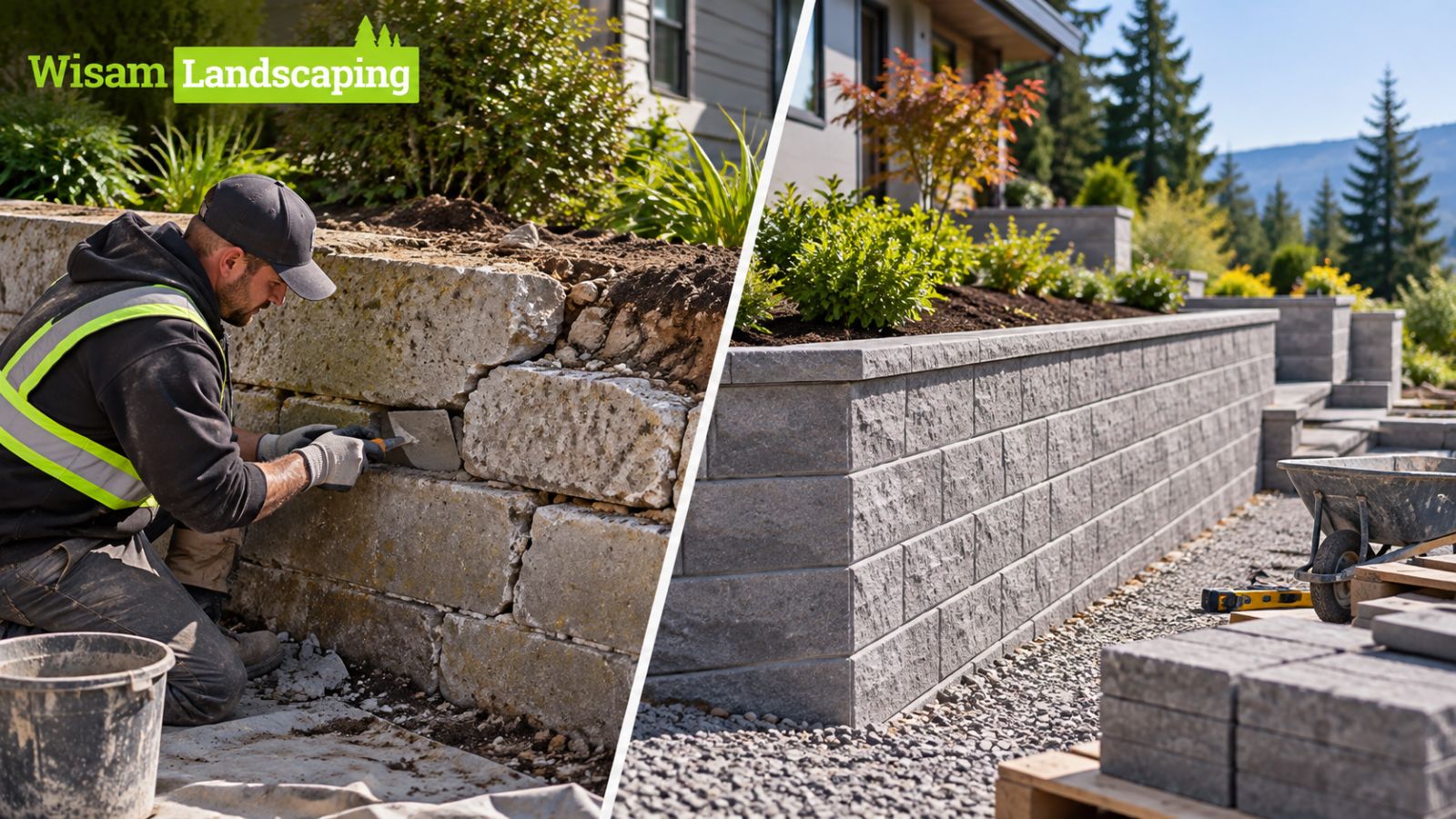
A retaining wall can look like a simple landscaping feature, but its job is far more important than appearance. It holds back soil, manages changes in elevation, protects parts of a property from erosion, and can help direct water away from areas where it could cause damage.
That is why a leaning, cracked, bulging, or deteriorating wall should not be treated as purely a cosmetic problem.
The difficult question for many homeowners is whether the existing wall can be repaired or whether replacing it is the better long-term solution. Sometimes a targeted repair is all that is needed. In other cases, repairing the visible damage without addressing the underlying cause simply postpones a much larger problem.
This Retaining Wall Repair Guide explains how professionals assess damaged walls, what signs suggest repair or replacement, how drainage affects wall stability, and what homeowners should consider before starting work.
Whether your wall is made from concrete blocks, timber, natural stone, or another material, the right decision depends on the condition of the structure, the soil behind it, drainage, wall design, age, and the extent of the damage.
For homeowners considering Retaining Wall Repair or planning future Retaining Wall Installation Vancouver, understanding these factors can help you make a more informed decision.
A retaining wall is constantly dealing with pressure.
The soil behind it pushes against the wall, while groundwater can add significant hydrostatic pressure. Changes in moisture, poor drainage, soil movement, tree roots, freezing and thawing, and inadequate construction can all affect its performance.
A small crack does not automatically mean a wall is failing. Likewise, a wall that looks reasonably attractive can have serious problems hidden behind it.
Some warning signs include:
The important question is not simply, “How bad does the wall look?”
It is:
Why has the wall moved or deteriorated, and can the underlying problem be corrected without rebuilding it?
That distinction is central to good retaining wall work.
Repair is often the most practical option when the wall is fundamentally sound and the damage is limited.
For example, a wall may have a small damaged section caused by impact, localized settlement, or deterioration of individual components. If the rest of the structure remains properly aligned and stable, replacing the entire wall may be unnecessary.
A professional may consider repair when:
The repair approach depends heavily on the wall type.
A segmental block wall, for example, may allow damaged blocks to be removed and rebuilt. A natural stone wall may require carefully resetting individual stones. Timber retaining walls can sometimes have deteriorated sections replaced, although extensive decay may indicate that the wall is nearing the end of its useful life.
The key is to repair the cause, not just the visible symptom.
One of the biggest mistakes homeowners make is focusing on cracks or movement without considering what is happening behind the wall.
Suppose a wall has started leaning outward. A contractor could theoretically push the visible section back into position, but that does not solve the problem if water continues accumulating behind it or the foundation remains unstable.
In this situation, the wall may move again.
More extensive Structural Damage may be present when you see:
These conditions warrant a more detailed assessment.
A retaining wall that has repeatedly failed in the same location is particularly important to investigate. Rebuilding the same design with the same drainage arrangement may simply reproduce the original problem.
A retaining wall does not need to be perfectly straight to be safe, but substantial movement should never be dismissed.
Wall Stability depends on several factors working together:
That last factor is easy to overlook.
A driveway, shed, fence, swimming pool, large tree, or heavily used area near the top of a retaining wall can place additional loads on the soil behind it. A wall that was adequate for a simple garden bed may not have been designed for significant surcharge loads.
This is why a proper assessment should consider the surroundings rather than examining the wall in isolation.
If there is one issue homeowners should pay particular attention to, it is water.
A retaining wall is designed to resist soil pressure, but trapped water can dramatically increase the load behind the structure.
This is why Drainage Problems are associated with many retaining wall failures.
After rainfall, water naturally moves through soil. If there is nowhere for that water to escape, pressure can build behind the wall.
Look for:
A proper retaining wall system may incorporate drainage aggregate, perforated drainage pipe, filter fabric, outlets, or other site-specific drainage measures.
The exact arrangement depends on the wall design and site conditions.
If a wall is repaired without correcting a drainage problem, the repair may have a short lifespan.
Soil Erosion can gradually undermine a wall even when there are no obvious cracks at first.
Water running across the landscape can carry fine soil away. Over time, this can create voids beneath or behind parts of the wall.
Erosion can also expose the base, disturb the foundation, and cause sections of the structure to settle unevenly.
For example, imagine a retaining wall beside a sloped lawn. During heavy rain, water repeatedly runs toward one corner of the wall. The homeowner notices that the corner appears slightly lower than the rest.
At first, it may seem like a minor landscaping issue.
But if water has been removing soil beneath that section, the wall could gradually lose support.
A good inspection should therefore consider water movement across the entire area, not just the wall itself.
Natural and manufactured stone walls can present different repair challenges.
A Stone Wall may be repairable when only a few stones have shifted or when localized deterioration has occurred.
However, a wall that relies heavily on gravity, interlocking components, or carefully placed stones can become unstable when larger sections move.
Trying to preserve every component of an old wall is not always the most economical decision.
Sometimes rebuilding a smaller section correctly provides better value than repeatedly repairing a failing structure.
Retaining walls are often part of a larger Hardscaping design.
They may sit beside:
This means wall movement can affect other parts of the property.
A leaning retaining wall beside a patio, for instance, may eventually place pressure on paving or alter drainage patterns. Similarly, a wall supporting a landscaped slope may affect the soil above it if it fails.
When planning repairs, consider the entire outdoor area rather than treating the wall as an isolated feature.
A repair that protects the wall but redirects water toward the patio may create another problem.

A retaining wall can look excellent immediately after construction and still have underlying weaknesses.
Good Construction involves more than selecting attractive materials.
Depending on the wall type and site, important considerations may include:
The appropriate method depends on wall height, soil conditions, materials, location, drainage requirements, and applicable local requirements.
This is also why homeowners should be cautious about copying a retaining wall design simply because it worked on a neighbouring property.
Two properties can have very different soil, slope, water, and loading conditions.
Good Landscaping can complement a retaining wall, but plant selection and placement deserve consideration.
Large trees planted too close to a wall can create issues through root growth, soil disturbance, or increased moisture demands.
At the same time, appropriate vegetation can help control surface erosion and improve the appearance of the landscape.
The goal is to select plants that suit the site without creating excessive pressure or maintenance problems.
When repairing or replacing a wall, it is often worth reviewing the landscaping immediately above and below it.
Ask:
These questions can reveal problems that would otherwise remain hidden.
The decision becomes easier when you compare the condition of the structure with the likely long-term outcome.
| Factor | Repair | Replacement |
|---|---|---|
| Small localized damage | Often suitable | Usually unnecessary |
| Minor cracks | May be suitable after assessment | Not always required |
| Major leaning | May be difficult | Often worth considering |
| Failed foundation | Usually limited | Often more appropriate |
| Severe drainage failure | Requires correction | May be necessary |
| Widespread deterioration | Temporary option in some cases | Often better long-term |
| Repeated failures | Less attractive | Often preferable |
| Structurally sound wall | Good candidate | May be unnecessary |
| Significant redesign required | Limited benefit | Better opportunity |
This is not a substitute for an on-site assessment, but it illustrates the basic principle:
Repair makes sense when the structure can reasonably be restored. Replacement makes sense when the underlying system is no longer reliable or appropriate.
Before deciding what to do, work through the following steps.
Take photographs from several angles.
Include:
If the condition changes, dated photographs can also help you track movement.
Check what happens during and after rainfall.
Does water collect behind the wall?
Does it run toward the wall?
Are drainage outlets blocked?
Is soil being washed away?
These observations can be extremely useful during an assessment.
Think about what has changed around the wall.
For example:
A wall that was stable for years can begin moving after changes to the site.
If there is substantial movement, structural damage, or uncertainty about safety, have an appropriately qualified professional assess the situation.
Do not rely solely on visual appearance.
Ask what each option actually involves.
A low-cost repair may appear attractive, but if it needs to be repeated every year, rebuilding may provide better long-term value.
Conversely, replacing a wall that could have been economically repaired wastes useful material and money.
A crack may be the result of movement rather than the primary problem.
Filling the crack without understanding why the wall moved may not solve anything.
This is one of the most common mistakes.
Water should be treated as part of the structural equation, not simply a landscaping concern.
Raising the grade behind an existing wall increases the load it must resist.
Before adding significant soil, assess whether the wall was designed for the additional pressure.
Trees can become a problem when their roots, size, or water requirements conflict with the retaining structure.
If poor drainage caused the original failure, replacing the wall without improving drainage leaves the same weakness in place.
A wall may look straight from the front while showing substantial movement from the side.
Walk along the entire length and look for changes in alignment.
Old damage that has remained unchanged is different from a crack that is actively widening.
If you notice new movement after heavy rain or seasonal changes, take it seriously.
Older walls may have materials or construction methods that make repeated repairs less practical.
A repair may restore the immediate problem without addressing the limitations of the original design.
Inspect the slope, drainage, paving, vegetation, and structures surrounding it.
Retaining wall performance is closely connected to the site around it.
The cheapest option today is not necessarily the cheapest option over time.
Ask whether the proposed repair is likely to provide a durable solution or simply delay replacement.
Sometimes an inspection makes it clear that the existing structure has reached the point where replacement is more sensible.
This can happen when the wall has extensive movement, widespread deterioration, an inadequate foundation, persistent drainage issues, or a design that no longer suits the property.
In these situations, Retaining Wall Installation in Vancouver can involve more than simply rebuilding the same wall.
A replacement project provides an opportunity to reconsider:
That does not mean replacement is automatically better. It means that when rebuilding is necessary, the new design should address the reason the previous wall failed.
Depending on the wall’s height, location, proximity to property boundaries or structures, and local requirements, permits or professional engineering input may also be necessary. A reputable contractor should identify when additional technical or regulatory review is appropriate rather than making assumptions.
Homeowners often focus on the quoted construction price.
That is understandable, but it is only one part of the decision.
Consider the total cost over the wall’s expected service life.
A repair might cost less today but require additional work in two or three years. A properly designed replacement may have a higher upfront cost but provide a more reliable solution.
When comparing quotes, ask:
Clear answers are more valuable than simply choosing the lowest number.
There is no single answer to the question of whether a retaining wall should be repaired or replaced.
If the structure is fundamentally sound and the damage is limited, Retaining Wall Repair can be a sensible and cost-effective solution.
If the wall has extensive structural damage, significant movement, a failed foundation, serious drainage issues, or a history of repeated failures, replacement may provide a more dependable long-term result.
The most important lesson from this Retaining Wall Repair Guide is simple: don’t treat the visible damage as the whole problem.
Look at water, soil, drainage, foundation conditions, surrounding landscaping, loading, and the original construction. A wall that is repaired properly should have the underlying cause of the problem addressed—not merely the symptom covered up.
For homeowners in Vancouver, Wisam Landscaping can help assess the practical considerations involved in maintaining, repairing, or rebuilding a retaining wall. The right solution should be based on the actual condition of the structure and the needs of the property, rather than a one-size-fits-all approach.
Look for the extent and pattern of the damage. Small, localized cracks or damaged individual components may be repairable if the wall remains stable. Significant leaning, widespread bulging, foundation movement, major displacement, or repeated failures may indicate that replacement is more appropriate.
Drainage should also be investigated. If water is building up behind the wall, repairing the visible damage without correcting the drainage can lead to another failure.
Yes. Poor drainage can allow water to accumulate behind the wall, increasing pressure on the structure. Saturated soil can also behave differently from properly drained backfill.
If a wall starts leaning after periods of heavy rain, investigate water movement rather than assuming the wall simply needs to be pushed back into position.
No. Not every crack means a retaining wall is failing.
The location, size, direction, progression, and surrounding movement all matter. A small surface crack in a masonry component is very different from a large horizontal crack accompanied by outward movement.
If cracks are growing, the wall is leaning, or other structural warning signs are present, professional assessment is advisable.
Minor landscaping repairs may be manageable for an experienced homeowner, but structural retaining wall work requires more care.
The taller the wall and the greater the soil load behind it, the more important design, foundation, drainage, and stability become. If the wall is significantly leaning, retaining a large amount of soil, supporting a nearby structure, or showing substantial damage, professional assessment is the safer approach.
Start with water management. Keep drainage systems clear, prevent surface water from concentrating behind the wall, and address irrigation leaks promptly.
Also avoid adding substantial soil or heavy structures above an existing wall without checking its capacity. Maintain appropriate vegetation, watch for erosion, and inspect the wall periodically for new cracks, movement, or drainage changes.