

A new driveway is a significant investment, but many homeowners focus on the installation cost without considering the more important question: How long will the driveway actually last?
The answer depends on much more than the material you choose. Installation quality, subgrade preparation, drainage, vehicle loads, weather exposure, maintenance, and how quickly small problems are addressed can all influence the useful life of a driveway.
For homeowners researching Driveway Installation in Vancouver, this is particularly important. Vancouver’s wet climate creates different challenges from regions with prolonged dry conditions or severe winter weather. Frequent rainfall makes drainage and water management critical, while occasional freezing temperatures can contribute to cracking when moisture enters vulnerable areas and freezes.
A properly planned driveway can provide many years of reliable service. However, there is no single lifespan that applies to every property.
This Driveway Lifespan Guide explains the realistic service life of common driveway materials, what causes premature deterioration, how Vancouver’s conditions affect performance, and what homeowners can do to protect their investment.
When discussing driveway lifespan, it is useful to distinguish between expected service life and visual condition.
A driveway may still be structurally usable while showing cracks, stains, surface wear, or fading. Conversely, a driveway can look acceptable from a distance while having underlying drainage or subgrade problems that eventually lead to major failure.
Several factors influence longevity.
Concrete, asphalt, interlocking pavers, and other paving systems have different characteristics.
The material needs to suit:
Choosing a material simply because it looks attractive can lead to disappointing results if it is unsuitable for the site.
The surface you see is only one part of a driveway.
Below it is the base and subgrade, which support the finished surface. If the underlying soil is unstable, poorly compacted, excessively wet, or inadequately prepared, the driveway can settle or move regardless of how expensive the surface material is.
This is one reason professional installation is fundamentally different from simply placing paving materials on the ground.
Water is one of the most important considerations in driveway construction.
Poor drainage can contribute to:
In Vancouver, where rainfall is a regular part of the climate, drainage should be considered during design rather than treated as an afterthought.
Even good materials can fail prematurely when installed incorrectly.
The installation process needs to account for excavation, grading, base preparation, compaction, surface installation, joints, edges, and drainage.
The details vary depending on whether the project involves concrete, asphalt, pavers, or another system.
There is no universal lifespan guarantee because site conditions and maintenance vary. However, homeowners can use general ranges as a planning guide.
A well-designed and properly installed Concrete Driveway can commonly provide around 25 to 40 years or more with appropriate care.
Its longevity depends heavily on:
Concrete is popular because it offers a clean appearance and substantial structural capacity.
However, concrete is not maintenance-free.
Small cracks should be monitored and addressed appropriately, particularly where water can enter. Drainage should also prevent water from repeatedly accumulating against the slab or its edges.
A common mistake is assuming that a thick-looking concrete surface automatically means a long-lasting driveway. The underlying preparation and installation details matter just as much.
A properly installed asphalt driveway may last approximately 15 to 25 years, although conditions can push that range higher or lower.
Asphalt has several practical advantages:
However, asphalt can deteriorate when water enters cracks and the underlying structure becomes compromised.
Routine maintenance can significantly influence its useful life.
Depending on the driveway and local conditions, maintenance may include crack repair, cleaning, drainage management, and periodic surface treatments when appropriate.
A properly installed Paver Driveway can potentially last 25 to 50 years or longer, particularly when the underlying base is constructed correctly and individual damaged pavers can be replaced.
One of the major advantages of interlocking pavers is repairability.
If a small area becomes damaged or settles, it may be possible to remove and reinstall the affected section rather than replacing the entire driveway.
Pavers also provide design flexibility through different:
However, pavers are not immune to problems.
Poor base preparation can result in uneven surfaces, while inadequate drainage can contribute to settlement or joint problems.
The material itself may be durable, but the installation system determines much of its long-term performance.
When homeowners compare driveway quotes, they often focus on the visible surface.
A more useful question is:
What is being done underneath the surface?
A quality driveway installation generally starts with evaluating the existing conditions.
Depending on the site, this can involve:
The exact construction method depends on the material and site.
For example, a paver installation relies heavily on a stable, compacted base because movement beneath the pavers can eventually become visible at the surface.
Concrete requires different considerations, including slab design, joints, curing, and drainage.
This is why comparing contractors solely by the final square-foot price can be misleading.
Two contractors may quote different prices because they are proposing different levels of excavation, base preparation, drainage work, materials, or finishing.
Vancouver’s climate presents a particular combination of wet weather and relatively mild winters.
The most obvious issue is rainfall.
Water needs somewhere to go.
A driveway should be designed so water does not remain concentrated against the home, garage, retaining walls, or other vulnerable structures.
Repeated water exposure does not necessarily destroy a driveway by itself. The bigger concern is uncontrolled water movement.
If water repeatedly enters cracks, washes out edges, saturates the base, or accumulates beneath sections of the driveway, structural problems can develop.
A professional should consider:
Although Vancouver is not known for prolonged extreme winter conditions, freezing temperatures can still occur.
When moisture enters small cracks or porous areas and subsequently freezes, expansion can place stress on the material.
This makes preventative maintenance worthwhile even when severe winter conditions are relatively uncommon.
A driveway does not necessarily need major intervention every time it develops a minor defect.
In many cases, early attention can prevent a small problem from becoming a larger structural issue.
Look for:
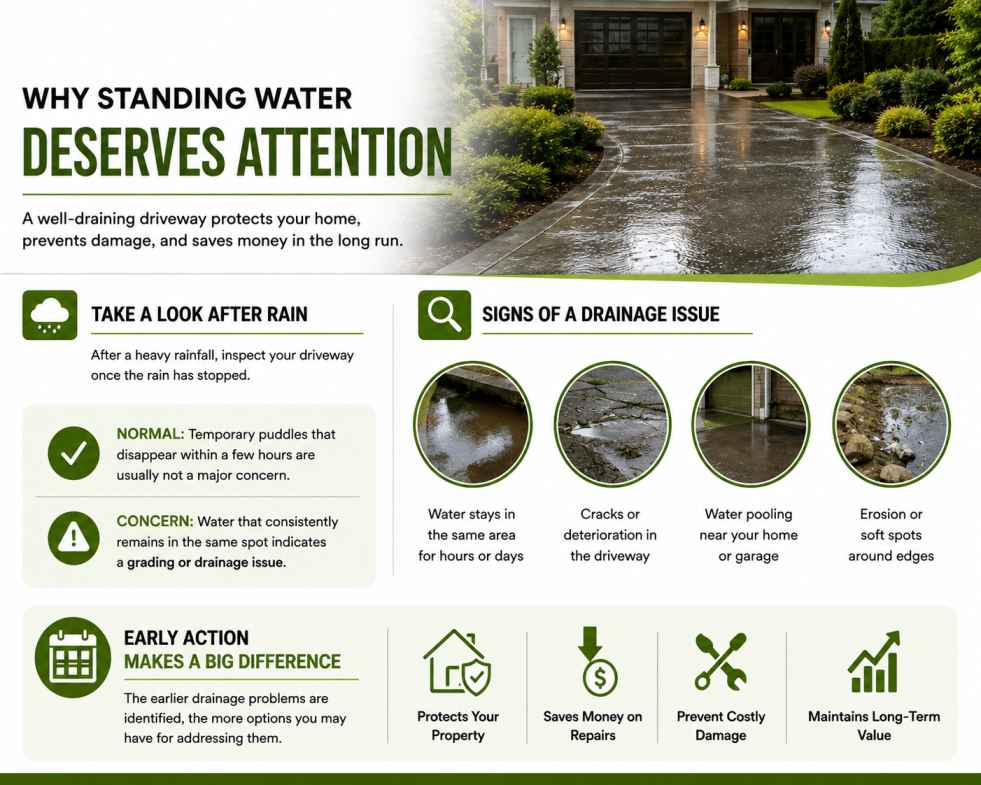
After a heavy rainfall, take a look at the driveway once the rain has stopped.
If water consistently remains in the same location, there may be a grading or drainage issue.
Occasional temporary puddling is not necessarily evidence of a major problem. Persistent pooling, however, deserves investigation.
The earlier drainage problems are identified, the more options you may have for addressing them.
If you have a concrete driveway, maintenance should focus on keeping the surface and surrounding drainage in good condition.
Not every crack means the driveway has failed.
Concrete can develop minor cracks over time due to shrinkage, movement, environmental exposure, or other factors.
The important questions are:
A contractor can assess whether a crack is cosmetic, maintenance-related, or indicative of a larger structural problem.
Ensure nearby downspouts are not directing concentrated water onto the driveway or its edges.
Likewise, landscaping should not create conditions where soil and water continuously accumulate against the concrete.
Some de-icing products can be harsh on concrete and surrounding landscaping.
Use products according to manufacturer instructions and avoid assuming that more product means better performance.
Paver driveways have the advantage of being relatively repairable, but they still need maintenance.
Inspect for:
If a small section settles, addressing it early may involve lifting the affected pavers, correcting the underlying base, and reinstalling them.
Waiting until a large area becomes uneven can make the repair more extensive.
This is one of the reasons many homeowners appreciate paver systems as part of a broader residential hardscape design.
Not every damaged driveway needs complete replacement.
However, replacement may make more sense when deterioration is widespread or the underlying structure has failed.
Consider professional assessment when you see:
For example, imagine a homeowner who has repeatedly patched the same section of an aging driveway.
The patches may temporarily improve appearance, but if the underlying base continues to move or retain water, the same problem can return.
In that situation, another surface repair may simply delay the inevitable.
A proper Driveway Replacement Vancouver project should identify why the old driveway failed rather than simply installing a new surface over the same underlying problem.
Age alone does not determine whether a driveway needs replacement.
Instead, look at the combination of age, condition, performance, and repair history.
A driveway approaching the end of its useful life may show multiple problems at once:
One small crack is very different from a driveway covered in interconnected cracking and settlement.
The latter suggests that the issue may extend beyond the surface.
The cheapest quote may not represent the lowest long-term cost.
Compare what each contractor is actually providing, including excavation, base preparation, drainage, materials, labour, cleanup, and warranty terms.
A new surface cannot reliably correct a fundamentally unstable foundation.
If the existing base is inadequate, installing a new surface over it may only postpone the problem.
A beautiful driveway that does not drain properly can become a recurring maintenance problem.
Small defects are usually easier and less expensive to address than extensive structural deterioration.
Even durable driveway materials benefit from inspection and routine care.
Maintenance is not about preventing every defect. It is about identifying manageable problems before they become expensive ones.
Driveways designed primarily for passenger vehicles may not be suitable for repeated heavy commercial vehicles.
If you regularly park heavy trucks, trailers, RVs, or other large vehicles, discuss the expected loading before installation.
Edges are often overlooked, but they can be vulnerable to erosion, vehicle loading, and landscaping activity.
Keep surrounding soil and landscaping from undermining the driveway.
After periods of heavy rainfall, inspect for:
This simple habit can identify drainage problems early.
Tree roots can affect hardscape surfaces as they grow.
Before installing a new driveway, consider existing trees and potential root growth rather than evaluating the driveway area in isolation.
Keep records of:
This information can be valuable if repairs are needed later or if you sell the property.
A durable driveway starts before the first paving material is installed.
Look at drainage, soil, grades, vegetation, existing hardscape, and access.
Consider concrete, asphalt, pavers, or another suitable system based on performance and design requirements.
Make sure water has an appropriate path away from the driveway and surrounding structures.
Ask the contractor how the subgrade and aggregate base will be handled.
Tell the contractor what types of vehicles will regularly use the driveway.
Ask what the finished driveway will require over the next several years.
Do not compare only the surface material or total price. Compare the entire construction scope.
A driveway should be viewed as part of your property’s overall Residential Hardscape, not simply as a surface for parking a vehicle.
The right material, proper base preparation, effective drainage, quality installation, and consistent Surface Maintenance all contribute to a longer Driveway Lifespan.
For Vancouver homeowners, local weather and site drainage deserve particular attention. A driveway that looks excellent immediately after installation is only the beginning. Long-term performance depends on what is underneath it, how water is managed, how the surface is used, and how problems are handled over time.
If you are planning Driveway Installation Vancouver, focus on the complete system rather than the surface alone. And if your existing driveway is showing extensive deterioration, a professional evaluation can help determine whether targeted repairs or Driveway Replacement in Vancouver makes better long-term sense.
The most useful takeaway from this Driveway Lifespan Guide is simple: invest in proper preparation, choose materials for the actual conditions, manage water carefully, and address small problems before they become structural ones.
A well-planned driveway is not just a short-term improvement. It is an investment in the functionality, appearance, and long-term value of your home.
The lifespan depends on material, installation quality, drainage, soil conditions, traffic, and maintenance. As a general planning range, a properly installed concrete driveway may last around 25–40 years or more, asphalt around 15–25 years, and a well-built paver driveway 25–50 years or longer.
These are not guarantees. Poor drainage, unstable soil, excessive loading, or inadequate installation can shorten the lifespan considerably.
Neither is universally better.
Concrete can provide a strong, clean, relatively low-maintenance surface when properly designed and installed. Pavers offer design flexibility and can be easier to repair in sections because individual units can be removed and replaced.
The better choice depends on your property’s conditions, appearance preferences, budget, maintenance expectations, and installation requirements.
There is no single factor for every property, but proper underlying preparation and drainage are among the most important.
A high-quality surface installed over an unstable or poorly drained base can deteriorate prematurely. Conversely, an appropriately selected material installed over a properly prepared base with effective drainage has a much better opportunity to reach its expected service life.
A quick visual inspection several times a year is sensible, particularly after periods of heavy rainfall or significant weather changes.
Look for new cracks, settlement, standing water, loose pavers, erosion, and damaged edges. Early inspection does not mean every issue needs immediate repair; it simply gives you an opportunity to identify changes before they become more serious.
Replacement becomes more reasonable when damage is widespread, the base has failed, settlement keeps returning, drainage problems cannot be resolved through minor work, or repeated repairs are no longer providing a durable solution.
A professional assessment can help distinguish between surface-level maintenance and underlying structural failure. Replacing a driveway without correcting the cause of the original problem can simply recreate the same issue.