

When homeowners invest in an outdoor space, they usually want more than something that looks good on installation day. They want a surface that can handle Vancouver’s wet weather, everyday foot traffic, changing temperatures, outdoor furniture, and years of use without becoming a constant maintenance project.
That is where Interlocking Pavers in Vancouver homeowners choose can make a meaningful difference.
Unlike a single poured slab, interlocking pavers are individual units installed over a properly prepared base. Their flexibility, repairability, design options, and durability make them a practical choice for patios, walkways, driveways, garden paths, outdoor entertaining areas, and other hardscape projects.
One of the biggest Benefits of Interlocking Pavers is that they combine structural performance with design flexibility. When the installation is planned correctly, a paver surface can complement the architecture of a home while also providing a resilient outdoor area for everyday use.
At Wisam Landscaping, understanding how an outdoor surface will actually be used is just as important as choosing its colour or pattern. A patio used for weekend entertaining has different requirements from a frequently used walkway or vehicle-access area.
This guide explains why interlocking pavers can be such a strong long-term outdoor investment, what affects their performance, and what homeowners should consider before starting a project.
Interlocking pavers are manufactured paving units designed to fit together in a planned pattern. Depending on the application, they may be made from concrete or other paving materials and can be installed in a variety of colours, shapes, textures, and patterns.
Their key advantage is the way the finished surface works as a system.
A successful paver installation typically involves:
The pavers themselves are only one component. The preparation underneath them often has a much greater influence on long-term performance.
This is an important distinction for homeowners comparing quotes. Two projects can use similar-looking pavers but perform very differently if the underlying preparation, drainage, or installation quality is different.
A rigid surface can crack when underlying conditions change. Interlocking pavers have individual joints that allow a properly constructed surface some movement.
This does not mean pavers are immune to settlement or damage. Poorly prepared soil, inadequate base depth, drainage problems, and improper compaction can still cause sinking or uneven areas.
However, a correctly installed paver system has a major practical advantage: individual sections can generally be lifted and reset when localized repairs are necessary.
That repairability is one reason many homeowners consider pavers a long-term investment rather than simply an aesthetic upgrade.
Vancouver’s climate makes drainage and moisture management particularly important in outdoor construction.
Frequent rainfall means water needs to move away from structures and across the landscape without creating persistent pooling or destabilizing the installation.
This is why experienced Paver Installation in Vancouver projects begin with site assessment rather than simply choosing a pattern.
Before installation, several questions should be considered:
A beautiful paver patio cannot compensate for poor grading.
One common mistake is treating drainage as something to solve after the pavers have been installed.
The finished surface needs an appropriate slope so water does not remain trapped against the house or collect in low spots.
Depending on the site, drainage may also involve channels, catch basins, permeable paving systems, or other landscape drainage solutions.
The correct approach depends on the property’s existing conditions rather than a one-size-fits-all formula.
A patio is one of the most common applications for interlocking pavers, and it is easy to understand why.
A well-designed patio can become an extension of the home’s living space. It may provide room for:
But good Patio Construction starts with how people will use the space.
For example, consider a homeowner who wants a dining table, six chairs, and a barbecue. A patio that looks appropriately sized when empty may feel cramped once furniture is added.
An experienced design approach accounts for furniture dimensions, walking routes, door clearances, and the movement of people around the space.
Before selecting pavers, think about the activities that will happen on the finished surface.
If the patio will regularly host large gatherings, generous circulation space becomes important. If it is primarily for two people drinking coffee in the morning, the design priorities may be different.
The best outdoor investments solve an actual lifestyle need rather than simply filling available yard space.
Outdoor improvements should be evaluated on more than their initial purchase price.
A low-cost surface may become expensive if it requires frequent repairs, is difficult to maintain, or needs replacement sooner than expected.
Interlocking pavers can offer several long-term advantages.
If a localized section settles because of an underground issue, individual pavers can often be removed to access the problem.
After the underlying issue is addressed, the pavers can potentially be reset.
With a large monolithic surface, repairs may involve cutting and patching a section, which can leave a visible difference between the old and new material.
Good paver designs do not need to follow short-lived trends.
Neutral colours, balanced patterns, and materials that complement the home’s exterior can remain visually relevant for many years.
Outdoor spaces sometimes change.
A homeowner may later install:
The modular nature of pavers can make certain future modifications more manageable.
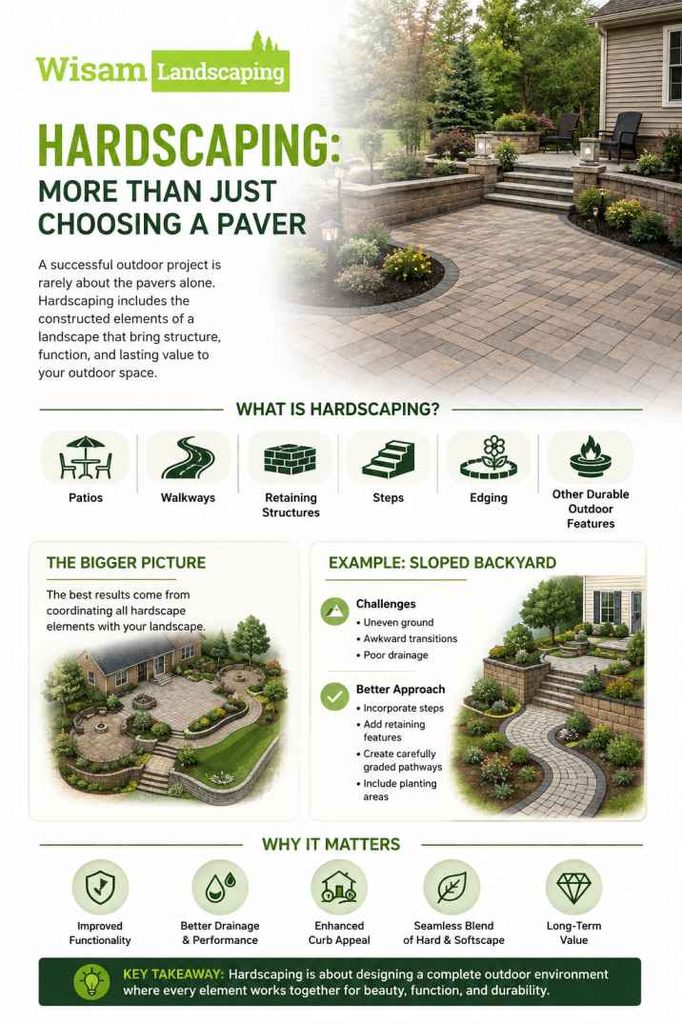
A successful outdoor project is rarely about the pavers alone.
Hardscaping includes the constructed elements of a landscape, such as patios, walkways, retaining structures, steps, edging, and other durable outdoor features.
The best results come from coordinating these elements.
For example, imagine a sloped backyard where the homeowner wants a patio connected to a garden pathway.
Simply installing a flat patio may create awkward transitions or drainage issues. Instead, the design might incorporate steps, retaining features, carefully graded pathways, and planting areas to create a coherent outdoor environment.
This is where site planning becomes particularly valuable.
A professional Hardscape Installation should consider how different components interact.
Important factors include:
A patio should not look like an isolated rectangle dropped into the yard. It should work with the surrounding landscape.
Material selection has both aesthetic and functional implications.
Natural-looking textures can help an outdoor area blend into a garden environment, while clean geometric patterns may suit contemporary architecture.
Natural Stone can create a distinctive appearance and is often used where homeowners want natural variation and character. Manufactured pavers, meanwhile, can offer consistent dimensions and a broad range of colours and patterns.
Neither option is automatically the right choice for every property.
A traditional home may work well with a more classic paving pattern, while a modern home might benefit from larger-format units and restrained colour combinations.
The goal is not to make the paving the only visual feature.
Instead, consider how the paving relates to:
A cohesive palette generally produces a more timeless result than combining too many competing colours and patterns.
Decorative Pavers allow homeowners to introduce visual structure without sacrificing the practical advantages of a hardscape surface.
Patterns can define different zones within one outdoor area.
For example, a border can visually frame a patio while a contrasting central pattern identifies the primary seating area.
Common design approaches include:
The choice should also consider the scale of the space.
A complicated pattern may become visually overwhelming in a small area, while a very simple layout can look under-designed in a large open patio.
Contrast can be effective, but more is not always better.
A subtle border or slightly different shade can create definition without making the patio feel busy.
For homeowners planning a long-term investment, restrained designs are often easier to live with than highly trend-driven combinations.
Paving should be considered alongside the planting and softscape design.
A patio surrounded by bare soil can feel unfinished, while strategic planting can soften hard edges and integrate the constructed surface into the garden.
Think about:
This is particularly important when a large paved area is being introduced into a relatively small yard.
More paving is not automatically better.
The most successful landscape designs typically balance hardscape with planting and usable open areas.
The objective should be to create enough durable surface for the intended activities while retaining the character and environmental function of the landscape.
When homeowners experience problems with pavers, the issue is often not the visible paving material.
It can be what is underneath.
The existing soil needs to be assessed and prepared appropriately for the intended application.
Soft, unstable, or poorly compacted areas can contribute to settlement.
The base provides structural support and helps distribute loads.
The appropriate depth depends on site conditions and intended use. A pedestrian patio and a vehicle-access area should not automatically receive identical preparation.
Proper compaction is essential.
Simply placing aggregate into an excavation is not enough. The material needs to be compacted correctly, generally in appropriate lifts, to create a stable foundation.
Pavers can shift laterally if their perimeter is not properly contained.
Edge restraints help maintain the intended layout and prevent gradual spreading.
Water management needs to be incorporated into the design before the surface is finished.
Persistent moisture can contribute to settlement, erosion, joint problems, or other complications depending on the site.
Consistent joint spacing, proper pattern alignment, clean edges, and careful cuts all contribute to the final appearance.
The details become particularly noticeable around steps, curves, drainage structures, and building entrances.
Even good paving materials can perform poorly when important installation principles are overlooked.
A paver may look perfect in a showroom but be inappropriate for the intended application.
Think about traffic, drainage, maintenance, exposure, and surrounding materials before making a decision.
This is one of the most important areas to evaluate when comparing estimates.
If one quote is significantly cheaper, determine whether the difference comes from material selection or from less extensive site preparation.
A patio should never be designed solely from a top-down visual perspective.
Elevation and water movement matter just as much as pattern and colour.
Remember that furniture takes up space.
Allow room for chairs to move, people to walk behind seating, and doors to open comfortably.
Multiple colours, patterns, borders, and textures can quickly make an outdoor area visually chaotic.
A limited palette usually creates a more cohesive appearance.
Pavers are relatively practical to maintain, but they are not maintenance-free.
Depending on the installation and surroundings, homeowners may need to deal with weeds in joints, organic debris, staining, moss or algae, and occasional movement or settlement.
Routine cleaning and timely repairs can help preserve the appearance and performance of the surface.
Before construction, mark out the approximate dimensions of furniture you expect to use.
This simple exercise can reveal whether the planned patio is genuinely large enough.
Pay close attention to where paving meets:
These transition points have a significant effect on both appearance and usability.
Ask what is included in the preparation.
A detailed estimate should make it easier to understand the scope of excavation, base preparation, installation, edging, drainage work, material, cleanup, and other relevant components.
If there is one part of a paver project that should not be treated as an afterthought, it is the base.
Beautiful pavers installed over inadequate preparation can still develop problems.
If underground utilities or drainage components may require future access, discuss this during planning.
A modular paving surface can sometimes make future access easier, but only if the installation is approached with that possibility in mind.
Not necessarily.
The right outdoor surface depends on the property, budget, intended use, site conditions, design objectives, and maintenance expectations.
Interlocking pavers are particularly attractive when a homeowner values:
However, homeowners should still compare options based on the complete project rather than the material alone.
For some properties, another paving system may make more sense.
The important question is not simply, “Are interlocking pavers good?”
It is:
“Are interlocking pavers appropriate for this specific site and how I plan to use it?”
That is where professional site evaluation and thoughtful design add real value.
The Benefits of Interlocking Pavers go well beyond curb appeal.
When properly designed and installed, they can provide a durable, adaptable, visually attractive surface that supports the way homeowners actually use their outdoor spaces.
For Interlocking Pavers in Vancouver projects, the most important decision is not simply selecting a colour or pattern. It is making sure the entire system—from excavation and base preparation to drainage, edging, installation, and finishing—is appropriate for the property.
A thoughtfully constructed patio can become a place for years of outdoor meals and gatherings. A well-planned walkway can improve movement through the garden. A carefully integrated hardscape can make an underused yard considerably more functional.
That is the real value of a good outdoor investment: it should make the property more usable today while continuing to perform well in the years ahead.
If you are considering a new patio, pathway, or other paver project, Wisam Landscaping can help you evaluate the practical requirements of your outdoor space and develop an approach that balances durability, functionality, and design.
A properly designed and installed paver surface can provide many years of service. However, longevity depends on factors such as soil conditions, drainage, installation quality, traffic levels, climate exposure, and maintenance.
The pavers themselves are only part of the system. A stable base, appropriate compaction, effective edge restraint, and proper water management are all important for long-term performance.
They can be, provided the installation is designed around the site’s drainage requirements.
The important consideration is not simply whether pavers can tolerate rain. The entire paving system needs appropriate grading, base preparation, and water management.
On properties with significant drainage challenges, additional drainage measures may be necessary.
There is no universal winner.
Poured concrete can provide a clean, continuous surface and may suit certain budgets and designs. Interlocking pavers offer modular construction, extensive design choices, and the ability to remove and replace individual units when localized repairs are needed.
The better option depends on the property, intended use, appearance, budget, and long-term priorities.
In many cases, yes. One of the practical advantages of an interlocking system is its modular construction.
Individual units can potentially be removed and replaced, while settled areas may be lifted, the underlying problem corrected, and the pavers reinstalled.
However, the exact repair method depends on why the movement occurred. Simply adding a new paver on top of an unstable area does not solve the underlying problem.
Look beyond photographs of finished projects.
Ask about the installation process, including excavation, base preparation, drainage, compaction, edge restraints, joint treatment, and cleanup.
It is also useful to ask how the contractor approaches unexpected site conditions. Experienced installers should be able to explain what can affect the project and how those issues would be handled.