

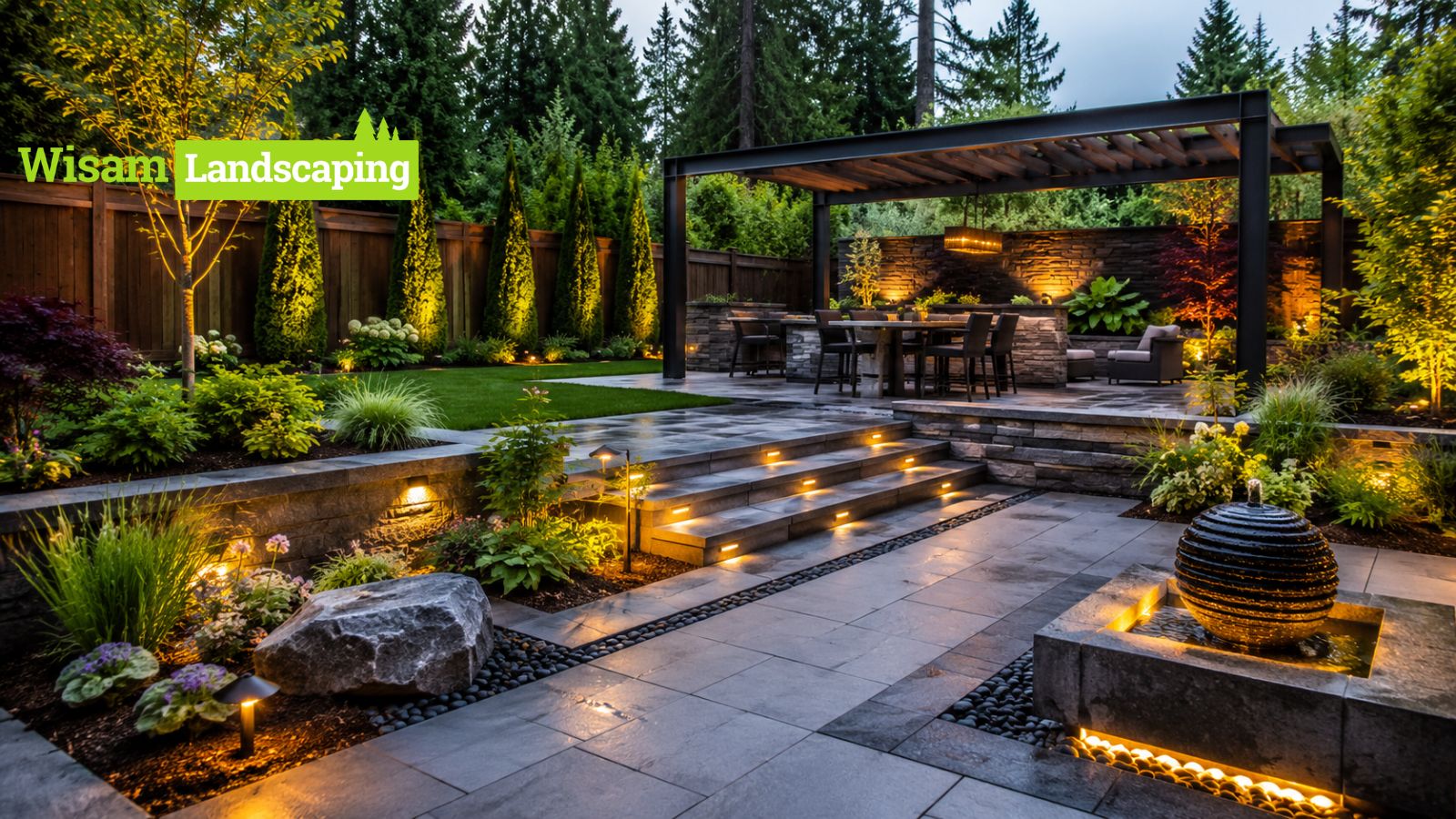
A Vancouver backyard has to do more than look attractive. It needs to handle wet winters, changing seasonal conditions, periods of summer dryness, limited urban space, and the practical realities of how a household actually uses its outdoor areas.
That is why today’s Landscape Design Trends Vancouver homeowners are considering are moving beyond purely decorative gardens. The strongest designs combine appearance with drainage, biodiversity, low-maintenance planting, usable outdoor rooms, and thoughtful long-term planning.
For homeowners researching Landscape Design in Vancouver, this shift is important. A beautiful landscape can become frustrating if water collects beside the house, plants struggle in the available light, a lawn demands constant attention, or a patio is positioned where nobody wants to sit. Good design starts with understanding the property and the people who use it.
At Wisam Landscaping, the practical lesson is straightforward: the best landscape is not necessarily the one with the most features. It is the one where planting, hardscaping, drainage, circulation, privacy, and outdoor living work together.
This guide explores the landscape ideas gaining attention in Vancouver and, more importantly, explains how to decide which ones make sense for your property.
Landscape preferences naturally evolve, but Vancouver’s environmental conditions make certain design approaches particularly relevant.
Rainwater management is an increasingly important consideration. The City of Vancouver promotes green rainwater infrastructure that uses plants, soil, trees, and constructed features to capture and manage rainfall. Its resources include rain gardens, bioretention systems, bioswales, permeable pavement, and other approaches.
At the same time, homeowners are looking for outdoor spaces that feel like an extension of the house rather than a separate patch of garden.
That means a modern landscape may combine:
The result is less about following a particular visual style and more about designing a landscape that performs well.
One of the most meaningful trends is Sustainable Landscaping.
Rather than treating sustainability as an add-on, good landscape planning incorporates environmental considerations from the beginning.
That might mean reducing unnecessary lawn, selecting plants appropriate to the site’s conditions, improving soil, retaining useful vegetation, or designing surfaces that allow rainwater to infiltrate where appropriate.
Vancouver’s own green rainwater infrastructure guidance recognizes landscape-based solutions such as absorbent landscapes and bioretention areas. These approaches can help manage runoff while also supporting biodiversity and improving the appearance of a property.
Imagine a narrow Vancouver backyard with a large paved area and a lawn that becomes saturated during wet weather.
Instead of simply replacing the lawn with more concrete, a designer could consider:
The objective is not to make the property look “natural” at the expense of usability.
It is to make the landscape function more intelligently.
Plant selection is becoming more thoughtful.
Rather than choosing plants solely because they look good at the garden centre, homeowners are increasingly considering whether plants are appropriate for the site’s sunlight, soil, moisture, exposure, and maintenance expectations.
The City of Vancouver’s water-wise landscape guidance includes plant-selection considerations such as sun and shade exposure, drought tolerance, evergreen structure, and native status.
The City’s garden-care guidance also recommends drought-tolerant plants, diverse species, evergreen elements, and plants that support pollinators while cautioning against invasive species.
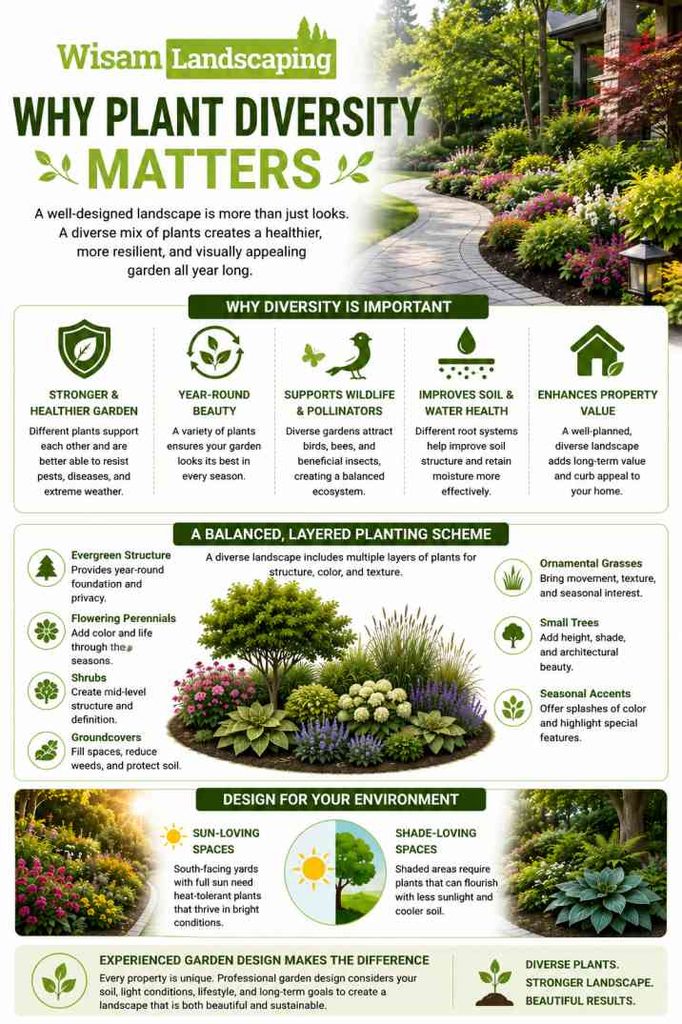
A garden composed of one or two plant varieties can look impressive when everything is healthy, but it can become visually flat and vulnerable if conditions change.
A layered planting scheme might include:
This creates visual interest at different heights and throughout the year.
For a shaded property, the plant palette should be different from a south-facing yard exposed to prolonged summer sun.
That is where experienced Garden Design becomes more valuable than simply copying a photograph from another property.
Modern Landscape Design does not necessarily mean a stark garden filled with concrete and minimalist furniture.
The more useful interpretation is intentionality.
Instead of having isolated features scattered around the yard, each element has a purpose.
For example:
This approach works particularly well in urban properties where space is limited.
A common mistake is adding one attractive feature after another without considering how they relate.
A backyard might contain:
Individually, each may look good.
Together, they can make a small yard feel crowded.
Good landscape planning asks a more important question:
What should this space allow the homeowner to do?
The answer should determine the features.
Outdoor entertaining remains an important direction in residential landscape design, but homeowners are increasingly interested in function rather than simply installing a large patio.
Outdoor Living Design can create different zones for different activities.
A compact backyard might include:
A table positioned close enough to the kitchen for convenient serving.
Comfortable seating placed where the homeowner can enjoy the garden rather than face a blank fence.
A barbecue or outdoor kitchen positioned according to available space, ventilation, utilities, and practical workflow.
Planting surrounding the hardscape to soften the space and provide seasonal interest.
The key is proportion.
A 20-square-metre backyard does not need four separate outdoor rooms.
Sometimes one well-designed multipurpose space works better.
Privacy is a major concern for many urban homeowners.
But privacy does not always require making the garden feel enclosed by tall fencing.
Layered planting can soften boundaries while creating a more natural visual transition.
Possible strategies include:
The important consideration is mature size.
A plant that looks appropriately sized when installed can eventually overwhelm a narrow garden if its growth habit was not considered.
Experienced Landscape Design accounts for the plant several years into the future—not just how it looks on installation day.
“Low maintenance” does not mean “no maintenance.”
Every living landscape needs some level of care.
The goal is to reduce unnecessary work by designing the garden intelligently.
That can include:
Consider two gardens of identical size.
Garden A has several small lawn sections, narrow planting beds, numerous delicate plants, and complicated edging.
Garden B has one defined lawn area, larger planting zones, durable plants suited to the conditions, and straightforward pathways.
Garden B may still require maintenance, but its layout is easier to manage.
That is the difference between simply choosing low-maintenance plants and actually practicing good Garden Planning.
Rainwater management is one of the most Vancouver-specific considerations in contemporary landscaping.
A rain garden, for example, is a planted depression designed to temporarily receive and manage runoff. The City of Vancouver identifies rain gardens, bioretention areas, bioswales, and permeable pavement as examples of green rainwater infrastructure.
The City has also established technical resources for green infrastructure on private property, including guidance covering bioretention, rainwater tree trenches, infiltration systems, bioswales, and permeable pavement.
For homeowners, the takeaway is not that every yard needs a rain garden.
It is that drainage should be considered during Landscape Planning, particularly where hard surfaces, roof runoff, slopes, and planting areas interact.
A properly designed rain garden is not intended to remain permanently flooded.
It is part of a broader water-management strategy, and its feasibility depends on site conditions, soil, grading, drainage, and applicable requirements.
That distinction matters when discussing sustainable landscape ideas with a Designer.
Traditional impermeable paving directs rainfall across the surface.
Permeable paving can allow water to move through the surface into an appropriately designed underlying system.
This makes permeable surfaces an interesting option for:
However, permeability is not simply a matter of selecting a particular paver.
Subgrade preparation, drainage, soil conditions, installation quality, maintenance, and site grading all affect performance.
The City of Vancouver recognizes permeable pavement as one of its green rainwater infrastructure approaches.
A contractor or landscape professional should therefore evaluate the whole assembly rather than promising that any permeable product will automatically solve a drainage problem.
Another interesting direction combines a relaxed, natural appearance with intentional organization.
Instead of perfectly symmetrical planting beds, homeowners may choose:
The trick is avoiding a garden that looks accidental.
Naturalistic does not mean random.
A good designer still controls:
The garden should feel relaxed without becoming visually chaotic.
Large suburban yards are not the only places benefiting from thoughtful landscaping.
Vancouver has many compact urban properties where every square metre matters.
In a small yard, Landscape Design should prioritize multifunctionality.
For example, one paved area can function as:
Vertical space can also become valuable.
Trellises, wall-mounted planters, carefully positioned screening plants, and climbing vegetation can introduce greenery without consuming significant floor area.
A narrow side yard does not necessarily need to remain a purely functional passage.
With appropriate planning, it may incorporate:
The objective is to make constrained spaces useful rather than simply filling them with features.
Trends should provide inspiration—not dictate your entire project.
Before adopting an idea, ask five questions.
Consider:
A garden designed for frequent entertaining needs different priorities from one intended for quiet relaxation.
Be realistic about how much gardening you actually want to do.
Ask how plants, paving, fencing, structures, and trees will look after five or ten years.
The strongest landscape improvements often solve several problems simultaneously.
A strategically planted tree might provide shade, improve privacy, add habitat, and strengthen the garden’s visual structure.
That is better value than adding a decorative feature simply because it is fashionable.
A plant that thrives in one Vancouver garden may struggle in another.
Sun exposure, soil moisture, wind, drainage, and mature size all matter.
Large paved areas can reduce planting opportunities and change how rainwater moves through a property.
Hardscape should support how the yard is used rather than dominate it unnecessarily.
Drainage should be considered during the initial design.
Trying to correct water problems after patios, retaining walls, and planting have already been installed can be considerably more disruptive.
A landscape should have some form of seasonal structure.
Evergreens, bark, branching patterns, ornamental grasses, and carefully selected plants can maintain interest beyond peak flowering periods.
The City of Vancouver also recommends incorporating evergreens for winter interest and structure and selecting a diversity of plants with different blooming periods.
More plants and features do not automatically produce a better garden.
A coherent design with fewer, well-chosen elements can be more attractive and easier to maintain.
Before drawing a plan, observe the property.
Where does water collect?
Which areas receive afternoon sun?
Where does the family naturally walk?
Which windows need privacy?
Where are the existing trees?
What views should be preserved?
These observations often reveal more than a homeowner’s initial wish list.
Do not judge a tree or shrub by its nursery-container size.
Check its expected mature height, width, root characteristics, maintenance needs, and suitability for the location.
This is particularly important near buildings, fences, pathways, overhead utilities, and property boundaries.
People should not have to navigate around planting beds to reach the patio.
Pathways should follow natural movement patterns.
The strongest projects often make one element perform several jobs.
For example, a planting bed can:
This is efficient design.
When discussing a project with a Landscape Designer, homeowners should expect more than a list of plants.
A thorough design conversation should cover:
A professional approach also recognizes when a particular idea may not be appropriate.
For example, installing a large tree in a very confined location simply because the homeowner likes its appearance may create future maintenance or infrastructure problems.
Good advice sometimes means saying, “That feature would not work well here,” and explaining why.
The direction of residential landscaping is increasingly practical.
Homeowners want gardens that are attractive, but they also want them to be resilient, manageable, environmentally responsible, and useful.
Vancouver’s focus on green rainwater infrastructure reinforces this broader movement toward landscapes that perform ecological functions as well as aesthetic ones. The City’s current resources include private-property guidance and technical information for systems such as bioretention and infiltration.
That does not mean every residential landscape needs to become a technical stormwater project.
It means landscape decisions can be made with a wider understanding of how a property interacts with water, plants, people, and the surrounding environment.
The best Landscape Design Trends in Vancouver homeowners can adopt are not necessarily the most visually dramatic ones. They are the ideas that make an outdoor space work better over time.
A successful landscape should reflect the property, the climate, and the people who use it.
That could mean a rain garden instead of another section of impermeable paving, a carefully selected evergreen screen instead of an oversized fence, a compact outdoor room instead of an unnecessarily large patio, or a diverse planting scheme instead of dozens of unrelated plants.
For homeowners considering Landscape Design in Vancouver, the most valuable step is to begin with landscape planning rather than products or trends. Observe the site, identify the problems you want to solve, establish realistic maintenance expectations, and then choose design elements that support those goals.
At Wisam Landscaping, that practical approach is what turns a collection of outdoor features into a landscape that feels intentional, useful, and sustainable for years to come.
The most useful trends include sustainable planting, climate-suitable and diverse gardens, functional outdoor living spaces, naturalistic planting, improved rainwater management, permeable hardscaping, privacy planting, and lower-maintenance layouts. The right combination depends on the property’s conditions and the homeowner’s lifestyle rather than on what is currently fashionable.
Yes. Sustainability does not require a large property. A small garden can use suitable plants, reduce unnecessary lawn, improve soil, incorporate permeable surfaces where appropriate, and manage rainfall more thoughtfully. In Vancouver, landscape-based rainwater management can include approaches such as absorbent landscapes and appropriately designed bioretention features.
Start with the site rather than the plant catalogue. Evaluate sunlight, shade, soil, moisture, drainage, exposure, mature plant size, and maintenance requirements. A diverse combination of plants can provide year-round structure and seasonal interest. Vancouver’s own garden guidance recommends considering sun exposure, drought tolerance, diversity, evergreen structure, and avoidance of invasive plants.
Not necessarily. Lawn can still be useful for children, pets, recreation, or open visual space. The better question is whether the amount of lawn matches how you actually use the property. Reducing lawn may make sense where it is rarely used, difficult to maintain, or poorly suited to the site’s conditions, but eliminating it completely is not automatically the best solution.
Drainage should be considered during the initial design rather than after construction. Grading, patios, planting areas, retaining structures, downspouts, soil conditions, and existing drainage patterns can all influence how water moves through a property. Addressing these relationships early usually produces a more coherent and practical landscape than trying to retrofit drainage after everything has been installed.