

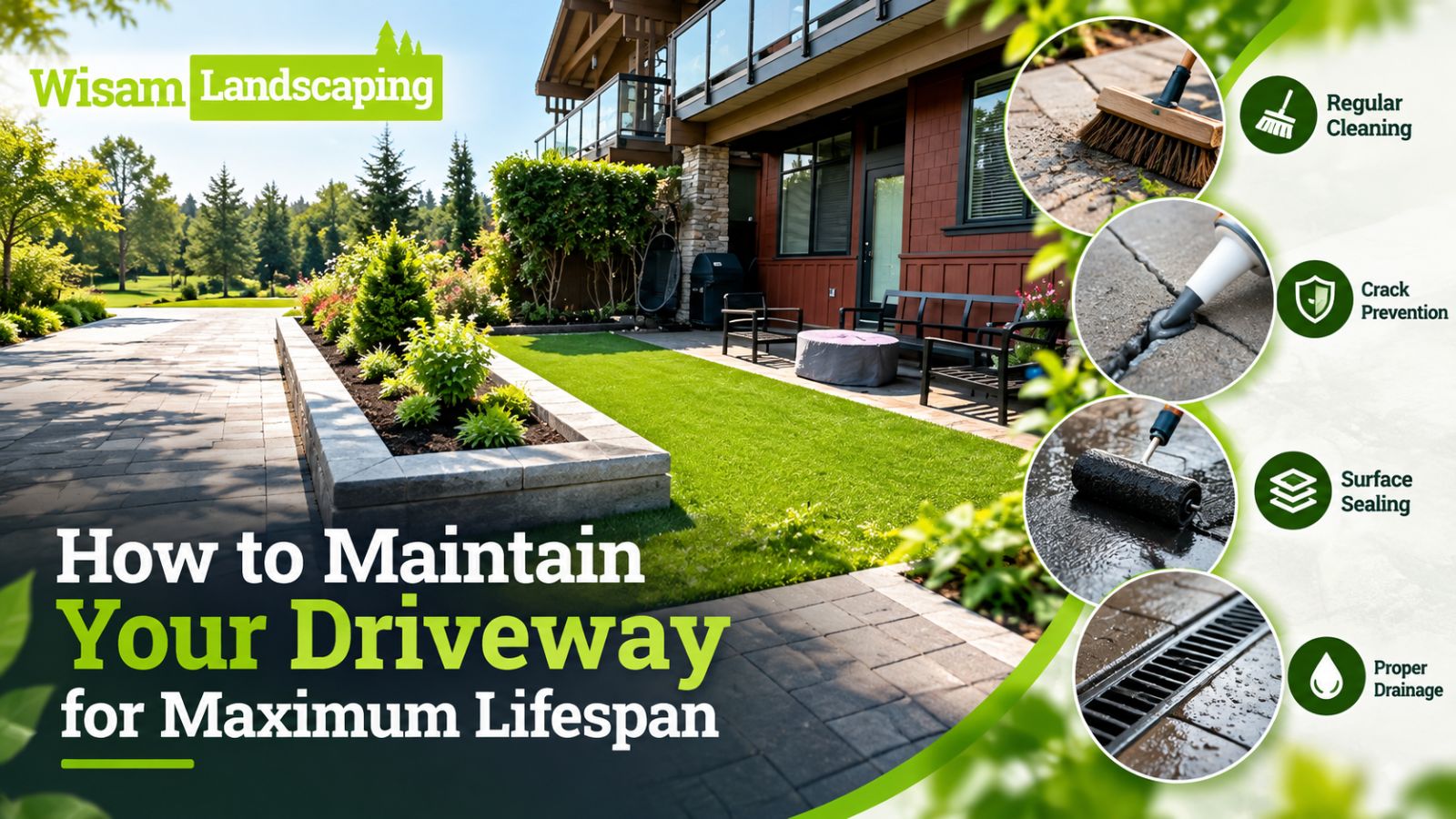
A driveway takes a surprising amount of punishment. Vehicles cross it every day, rain sits on its surface, winter temperatures can cause expansion and contraction, and dirt or organic growth can gradually affect the finish. Regular Driveway Maintenance can help identify small problems before they become expensive repairs. Whether you have a concrete, asphalt, paver or other hardscape driveway, the right care routine can protect the surface, improve appearance and extend its useful life. This Driveway Maintenance Guide explains what homeowners should inspect, clean, repair and protect throughout the year.
A driveway is often treated as a set-and-forget part of a property. Once the surface has been installed, many homeowners only think about it when a crack becomes obvious or a section begins to sink. Unfortunately, visible damage is often the result of smaller problems that have been developing underneath or around the surface for some time.
Regular inspections allow homeowners to spot early warning signs such as hairline cracks, standing water, loose pavers, surface erosion, faded sealant and deteriorating edges. Addressing these issues while they are manageable can reduce the likelihood of more extensive repairs.
Maintenance is also about understanding how the driveway interacts with the rest of the property. Gutters, downspouts, garden beds, retaining walls and nearby trees can all affect water movement and surface stability. A driveway that is technically well-built can still experience problems if drainage around it is poor.
Several factors can gradually weaken a driveway. Heavy vehicle loads, repeated moisture exposure, poor drainage, freeze-thaw cycles, tree roots and delayed repairs are common examples. The severity depends on the driveway material, installation quality, local conditions and how the property is used.
In Vancouver and surrounding areas, moisture deserves particular attention. Frequent rainfall can keep surfaces damp and expose cracks or joints to water repeatedly. During colder periods, trapped moisture can create additional stress when temperatures fall and rise. This makes preventative care particularly valuable.
A practical maintenance routine starts with a visual inspection. You do not need specialist equipment to identify many early warning signs. Walk the entire driveway and look closely at the surface, edges and areas where water tends to collect.
Look for:
Do not only inspect the centre of the driveway. Edges and transition points can experience different stresses, particularly where the driveway meets a lawn, garden bed, walkway or road.
Taking occasional photographs can make it easier to determine whether a crack or settlement issue is actually getting worse. A mark that appears unchanged for several seasons may require a different response from a crack that has visibly expanded within a few months.
This simple habit can also help when discussing a problem with a paving or landscaping professional. Instead of relying on memory, you can show when the issue appeared and how it developed.
Regular cleaning is one of the simplest ways to protect Paving. Dirt, leaves, moss, algae and other organic material can hold moisture against the surface and make small defects harder to see. On some materials, accumulated debris can also contribute to staining and surface deterioration.
Cleaning methods should match the driveway material. Concrete, asphalt and interlocking pavers do not necessarily respond the same way to pressure washing or cleaning chemicals. Excessive pressure can damage certain surfaces or force water into joints, while unsuitable chemicals may cause discolouration.
For routine cleaning, remove loose debris first. Sweep leaves and dirt away from drainage areas, then address stains using a method appropriate for the specific surface. If you are unsure, testing a cleaning solution on a small inconspicuous area is a sensible precaution.
The edges of a driveway are particularly vulnerable because they may lack the same structural support as the central surface. Soil erosion, lawn maintenance equipment, vehicle wheels and water runoff can gradually weaken these areas.
Keep soil and mulch from building up against the driveway edge. If landscaping changes the way water flows towards the pavement, correct the drainage issue rather than repeatedly repairing the resulting surface damage.
A Concrete Driveway can provide many years of service when installed correctly and maintained appropriately. However, concrete is not completely immune to cracking. Minor cracking can occur due to shrinkage, temperature changes, ground movement and other factors.
The important distinction is between a small, stable surface crack and a developing structural or settlement problem. Not every crack requires the same repair method.
Crack Prevention is not simply about filling cracks after they appear. Keeping water away from vulnerable areas is an important part of protecting the driveway.
Check whether downspouts discharge directly beside the driveway. Look for areas where rainwater consistently pools. Inspect nearby garden beds for soil erosion or water movement towards the pavement.
If water repeatedly reaches the same section, repairing the crack without addressing the source may provide only a temporary improvement.
A small hairline crack may not immediately indicate serious structural damage. However, cracks that become wider, extend across large sections, develop alongside settlement or repeatedly reopen deserve closer attention.
A professional assessment can help determine whether the issue is primarily surface-related or connected to the underlying base, drainage or ground conditions.
Surface Sealing can be useful for some driveway materials, but it should not be treated as a universal solution. The appropriate product, preparation and application frequency depend on the material, existing condition and manufacturer’s recommendations.
Sealing a damaged surface without repairing underlying problems can simply cover up an issue temporarily. Similarly, applying sealant too frequently or using an incompatible product can create its own problems.
Before sealing, the surface should generally be clean, suitably dry and free from significant defects that require separate attention. Proper preparation is often just as important as the sealing product itself.
If water is trapped beneath or around a driveway, sealing the top does not correct the drainage problem. Likewise, a sinking section caused by base failure may require structural attention rather than another surface coating.
Think of sealing as one component of maintenance, not a replacement for proper drainage, cleaning and repairs.
Drainage problems can quietly cause extensive driveway damage. Water may enter cracks, weaken supporting material, wash away soil or remain around the edges of the pavement. Over time, these conditions can contribute to settlement, cracking and surface deterioration.
Walk the driveway during or shortly after significant rainfall if it is safe to do so. Observe where water travels and whether it drains away naturally. Standing water that remains after surrounding areas have dried is worth investigating.
A blocked gutter or poorly positioned downspout can direct a surprising amount of water towards a driveway. Make sure roof drainage is not discharging directly onto vulnerable pavement sections.
Downspouts should direct water towards an appropriate drainage area rather than concentrating runoff beside the driveway. Where the property has more complex drainage requirements, professional assessment may be appropriate.
Driveways rarely exist independently from the rest of the property. Landscaping choices can influence water movement, soil stability and root growth around the pavement.
Trees planted too close to a driveway may eventually create challenges as roots grow. This does not mean every nearby tree is a problem, but mature vegetation should be considered when investigating recurring lifting or cracking.
Garden beds can also affect drainage. Raised soil beside a driveway may direct water towards the pavement rather than away from it. Maintaining a sensible transition between landscaping and hardscaping can reduce these problems.
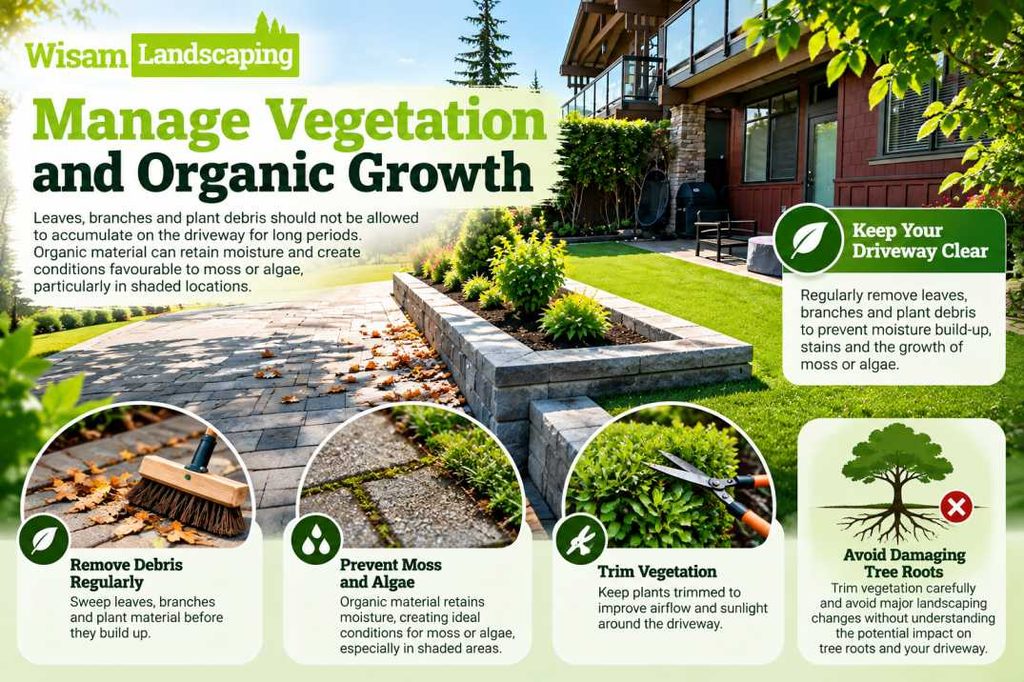
Leaves, branches and plant debris should not be allowed to accumulate on the driveway for long periods. Organic material can retain moisture and create conditions favourable to moss or algae, particularly in shaded locations.
Trim vegetation where appropriate to improve airflow and sunlight. However, avoid damaging tree roots or making major landscaping changes without understanding the potential consequences for the property.
Hardscaping includes more than the driveway itself. Walkways, patios, retaining walls, steps and other constructed outdoor features can influence how people, vehicles and water move through the property.
When one element begins to fail, it may affect another. For example, a deteriorating retaining edge could allow soil to move towards the driveway. A poorly positioned walkway could create a low point where water accumulates.
For this reason, driveway maintenance should consider the surrounding landscape rather than focusing exclusively on the pavement.
Driveways are designed for expected vehicle use, but unusually heavy loads can place additional stress on the surface and supporting base. Large delivery vehicles, construction equipment or temporary machinery may cause damage if the driveway was not designed to accommodate them.
If substantial vehicles need to access the property, consider the surface condition and load requirements beforehand. Preventing avoidable damage is generally easier than repairing a surface after excessive loading has occurred.
Homeowners sometimes assume that any visible deterioration means the entire driveway needs to be replaced. That is not necessarily the case.
Localised cracks, stains, minor surface deterioration or individual damaged pavers may be repairable. However, widespread cracking, major settlement, severe drainage problems or extensive structural deterioration can change the calculation.
A professional assessment should consider the age and condition of the driveway, the extent of the damage, the underlying cause and the likely performance after repair.
For homeowners researching Driveway Replacement Vancouver, it is worth understanding that replacement is generally a larger decision than simply removing an unattractive surface. If the underlying base or drainage system is failing, a replacement that does not address those conditions may experience similar problems again.
Replacement may become more practical when damage is extensive, the surface has reached the end of its useful life or repeated repairs are no longer providing reliable results. The decision should be based on condition and long-term value rather than appearance alone.
A simple routine can prevent maintenance from becoming overwhelming.
Remove leaves, branches and accumulated debris. Look for obvious cracks, standing water, loose materials and new stains. Check that drainage paths are not blocked.
Inspect the driveway more carefully after periods of heavy rain or extreme temperatures. Examine edges, joints and areas where water commonly collects. Check nearby landscaping for erosion or changes in water flow.
Review the overall condition of the driveway. Consider whether sealing, joint maintenance, repairs or drainage improvements are appropriate for the particular material. It can also be useful to compare current photographs with previous ones to identify gradual changes.
This routine does not guarantee that a driveway will never deteriorate, but it improves the chances of identifying manageable problems before they become extensive.
One common mistake is waiting until damage becomes obvious before taking action. A small crack is easier to investigate than a heavily deteriorated section.
Another mistake is using the same cleaning or sealing method for every driveway. Materials have different requirements, and an approach that works on one surface may damage another.
Ignoring drainage is another frequent problem. Repeatedly repairing a crack without determining why water reaches that area can lead to recurring maintenance costs.
Finally, homeowners sometimes concentrate on appearance while overlooking structural performance. A driveway can look relatively good while developing problems underneath. Regular observation of settlement, drainage and surface movement provides a more complete picture.
If you notice recurring pooling, investigate drainage before focusing on cosmetic repairs. Water management is often central to long-term surface performance.
Do not automatically treat every small defect as an emergency, but do not ignore changes either. Monitor cracks and deterioration and obtain professional advice when the condition is progressing.
Check manufacturer recommendations or consult someone familiar with the material before applying cleaners, sealants or repair products.
Good vegetation management, appropriate soil levels and sensible drainage can support driveway longevity.
Filling a minor crack may be straightforward, but structural settlement, significant drainage failures and extensive surface deterioration can require more specialised knowledge. An incorrect repair can make future work more complicated.
A long-lasting driveway is rarely the result of one maintenance task. It comes from a combination of sensible installation, regular inspections, good Concrete Care, effective drainage, appropriate cleaning, timely repairs and suitable protection. The earlier problems are identified, the more options a homeowner generally has for dealing with them.
Use this Driveway Maintenance Guide as a practical framework rather than a rigid checklist. Every driveway has different materials, site conditions and usage patterns, so maintenance should be adjusted accordingly. If a problem keeps returning, look beyond the visible damage and investigate the underlying cause.
For homeowners looking at long-term outdoor property care, Wisam Landscaping can be considered when driveway issues overlap with drainage, landscaping or broader hardscape conditions. A coordinated approach can be useful when the driveway and surrounding outdoor areas influence one another.
When maintenance concerns become more complex, Wisam Landscaping can also help homeowners consider the wider property environment rather than treating each outdoor feature as an isolated problem. The objective should always be practical: protect the existing investment where possible, address genuine underlying issues and choose replacement only when it provides better long-term value.
A quick visual inspection every month is useful, while a more thorough review should be completed seasonally and after significant weather events. The ideal schedule depends on the driveway material, age, traffic levels and surrounding conditions. Regular observation is more important than following a rigid calendar because new cracks, drainage changes or settlement can occur between planned inspections.
Sealing can provide useful surface protection for certain driveway materials, but it is not a cure for structural problems. Its effectiveness depends on the material, preparation, product and application. A driveway with drainage problems, significant cracking or a failing base should be assessed before sealing. Proper maintenance involves addressing the cause of deterioration rather than relying solely on a protective coating.
There is no single method that can guarantee a crack-free driveway. However, good installation, suitable base preparation, appropriate drainage, controlling water exposure and addressing small defects early can reduce the risk of deterioration. On concrete surfaces, following appropriate jointing and curing practices during installation is also important. Existing cracks should be monitored to determine whether they are stable or progressing.
Replacement may make more sense when deterioration is widespread, the underlying base has failed, settlement is extensive or repeated repairs are no longer providing reliable results. The age and remaining service life of the surface should also be considered. A professional assessment can help compare the likely cost and performance of repairing the existing driveway with installing a new system.
Yes, depending on the circumstances. Tree roots can sometimes contribute to lifting, while soil, mulch and garden beds can alter drainage around the pavement. Poorly directed irrigation or roof runoff can also expose the driveway to excessive moisture. Good landscape planning considers the relationship between plants, soil levels, drainage and hard surfaces so that the different parts of the property work together.