

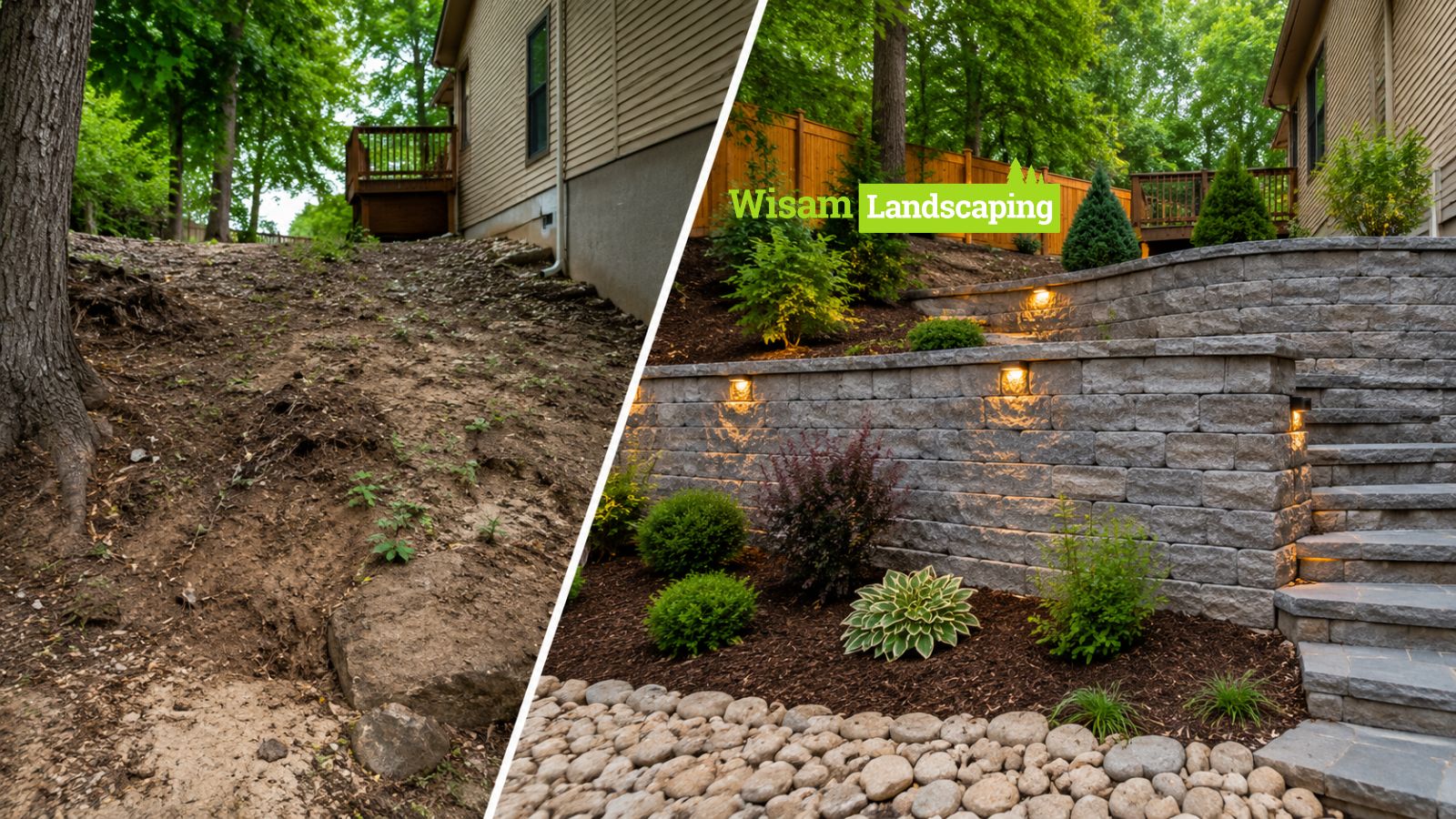
A sloped Vancouver yard can look attractive, but uneven ground becomes a practical concern when rain starts moving soil downhill, planting areas lose their shape, or water begins collecting where it should not. Knowing the Signs You Need a Retaining Wall can help you address those problems before they become expensive landscape or structural issues. A retaining wall is not simply a decorative feature. When properly planned, it can provide Structural Support, manage soil movement, improve usable outdoor space and form part of a broader drainage strategy.
A retaining wall is designed to hold back soil where there is a change in elevation. That sounds straightforward, but the forces acting on a wall are more complicated than simply the weight of the soil behind it. Soil pressure, water, slope conditions, drainage, wall height, foundation conditions and nearby loads can all affect performance.
This is particularly relevant in Vancouver, where properties can have sloping yards and wet conditions. Water that enters retained soil increases pressure behind the wall, while poor surface drainage can accelerate erosion around the structure. A well-designed system therefore needs to consider both the wall itself and what is happening to water and soil around it.
Homeowners sometimes assume a wall is needed only when a slope looks extreme. In practice, the decision is more nuanced. A modest-looking slope can still experience significant Soil Erosion if runoff repeatedly follows the same path. Conversely, some sloped yards may be managed effectively with grading, planting, swales or other Drainage Solutions without constructing a wall.
The goal is not to install a wall simply because one is possible. The goal is to determine whether a retaining structure is the appropriate response to the site’s actual conditions.
The following warning signs do not automatically mean a retaining wall is required. They indicate that the slope, soil or drainage deserves closer assessment. A professional site evaluation can determine whether a wall is appropriate and what type of solution would be suitable.
Repeated soil movement is one of the clearest warning signs. You might notice exposed roots, small channels forming after rainfall, sediment collecting at the bottom of the yard or planting beds gradually becoming lower on one side. These changes may appear minor at first, particularly after a single heavy rainfall, but recurring movement indicates that water and gravity are steadily reshaping the landscape.
This is a common point where homeowners benefit from acting before the problem becomes visually dramatic. If a slope is losing soil every wet season, replacing the displaced soil without addressing the underlying cause is usually only temporary. Depending on the site, the solution could involve improved drainage, vegetation, grading or a retaining structure that creates a more stable transition between elevations.
A steep or uneven yard can limit how much of the property you can actually enjoy. A slope may make it difficult to create a level lawn, establish usable garden beds, install seating or provide safe access between different areas. If you find yourself repeatedly working around the terrain rather than using the space as intended, changing the grade may be worth considering.
A retaining wall can create defined terraces, allowing a sloped property to become a sequence of more manageable levels. This can be particularly useful when homeowners want to create planting zones, patios or pathways. The design should still follow the natural characteristics of the site rather than forcing an impractical geometry onto the landscape.
One of the biggest mistakes homeowners make is treating drainage as an afterthought. A wall can be structurally sound and still perform poorly if water is allowed to build up behind it. That is why drainage needs to be considered during planning and Construction, rather than added after the wall is already installed.
Persistent puddling, saturated soil, muddy areas and concentrated runoff can indicate that water is not moving through the property effectively. After rainfall, pay attention to where water travels and where it remains. If water repeatedly concentrates beside a slope, near the base of an existing wall or around a proposed construction area, the drainage pattern should be understood before major work begins.
Depending on the site, drainage may involve surface grading, collection systems, perforated drainage pipe, free-draining aggregate or other engineered measures. The correct approach depends on soil conditions and the amount and direction of water entering the area. A retaining wall should not be expected to solve a drainage problem by itself.
If you already have a landscape wall, visible movement should not be dismissed as ordinary ageing. A wall that is leaning, bowing, cracking significantly or separating from adjoining sections may be experiencing excessive pressure or inadequate drainage. Soil movement, foundation settlement and water pressure are among the factors that can contribute to these symptoms.
A useful practical distinction is between cosmetic deterioration and structural movement. A small surface crack in masonry does not necessarily mean imminent failure, while a wall that has noticeably changed position deserves prompt attention. Avoid simply covering cracks or adding cosmetic materials before determining why the wall moved in the first place.
Some homeowners consider a retaining wall because they want more than erosion control. They may want to convert an unusable slope into terraces, create a defined garden area or establish a level space for outdoor living. In those situations, a Stone Wall or another retaining system can become both a functional structure and a landscape feature.
Material selection should follow the project’s requirements rather than being based solely on appearance. Natural stone, concrete segmental units, timber and other systems have different characteristics, installation requirements and maintenance considerations. The wall’s height, soil conditions, drainage requirements and surrounding landscape should all influence the final choice.
A well-integrated wall should look as though it belongs to the property. That means considering existing paving, planting, fences, pathways and architectural finishes. The best hardscaping projects tend to connect these elements instead of treating the retaining wall as an isolated object.
A slope becomes more concerning when erosion or instability approaches a home, garage, pathway, fence, utility feature or other significant element. The issue is no longer simply about maintaining an attractive garden. Continued soil movement can change grades and potentially affect foundations, access areas or other structures.
This is where professional judgement becomes particularly important. A retaining wall’s design needs to account for what is above and below it, including additional loads near the top of the retained soil. A driveway, building, pool, large tree or other feature can change the forces that the wall must resist.
Engineers and Geoscientists BC maintains professional practice guidance specifically for retaining wall design. Its current guideline addresses geotechnical aspects of retaining walls as well as certain structural and regulatory considerations.
Repeated repairs can be the most practical sign that the underlying landscape problem has not been solved. Perhaps soil is replaced every spring, mulch repeatedly washes away, a pathway settles after heavy rainfall or a garden bed keeps losing its shape. When the same issue returns despite maintenance, it is worth asking whether the site’s grade and water movement need a more permanent solution.
This does not automatically mean installing a retaining wall. Sometimes improved grading or vegetation is sufficient. In other cases, a retaining system combined with drainage and appropriate planting can address several problems simultaneously. The important point is to diagnose the cause rather than repeatedly treating the symptom.
When comparing Retaining Wall Contractors Vancouver, homeowners should look beyond photographs of completed projects. A retaining wall is a site-specific structure, so the contractor or professional involved should be able to explain how they intend to address soil, drainage, foundation preparation, wall type and the surrounding landscape.
Before work begins, ask questions such as:
Good answers should be specific to the property rather than a generic description of wall installation.
For Vancouver projects, regulatory requirements also deserve attention. The Province of British Columbia notes that the City of Vancouver is outside the provincial Building Code framework and operates under its own requirements. Current guidance published for BC professionals also notes that Vancouver’s Building By-law has specific requirements for retaining structures greater than 1.2 metres in height, including professional design and an assurance statement under the applicable provisions.
That does not mean every retaining wall project will require the same level of engineering or permitting. Requirements depend on the project and applicable local rules, so homeowners should confirm the current requirements before construction begins.
A wall installed directly into a poorly drained slope can be exposed to unnecessary water pressure. If the source of the water is not understood, the wall may be asked to perform a drainage function it was never designed to handle.
It is tempting to select a wall material based on colour or appearance. However, the appropriate material and construction method depend on wall height, loading, soil, drainage and site conditions. A beautiful material is not a substitute for a suitable design.
Even a relatively short retaining structure holds back soil and therefore needs a stable base and appropriate drainage. The risk increases as wall height, surcharge loads and challenging soil conditions increase.
Two adjacent properties can have different soil profiles, drainage patterns, grades and loads. A wall that has performed well next door may not be appropriate for your property. Site conditions should drive the design.
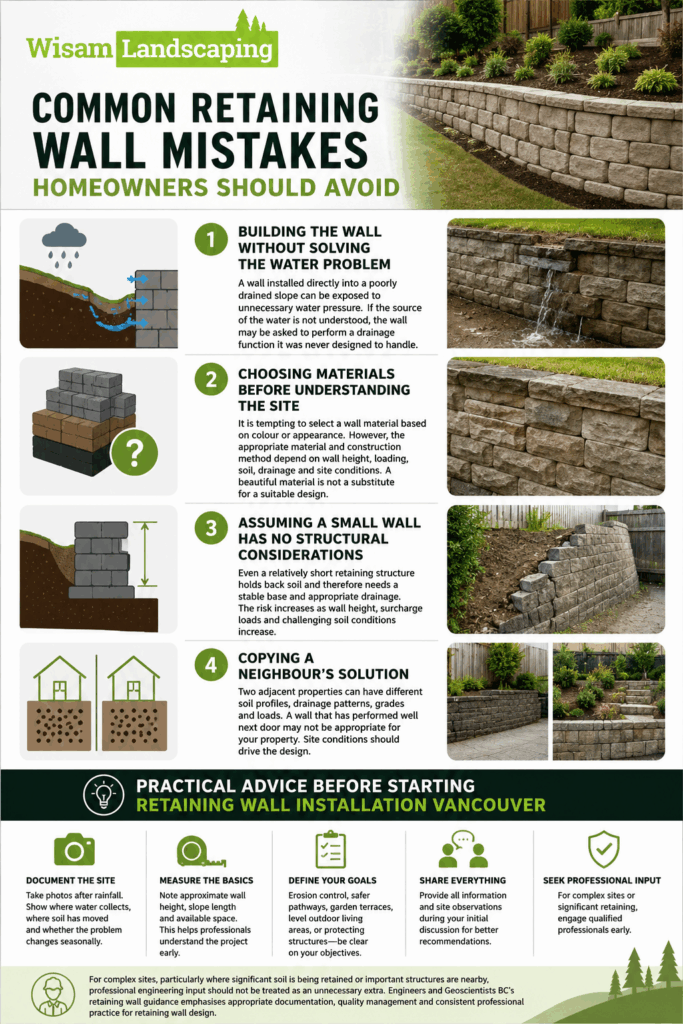
Before requesting quotes, take photographs of the affected area after rainfall. Show where water collects, where soil has moved and whether the problem changes seasonally. Measurements of approximate wall height, slope length and available space can also help the professional understand the project during an initial discussion.
It is equally useful to define what you want the finished landscape to accomplish. Are you primarily trying to stop erosion? Do you need a safer pathway? Are you creating garden terraces? Do you need a level outdoor living area? Or are you concerned about movement near an existing structure?
Clear objectives help distinguish between a structural problem and a landscape-design problem.
For complex sites, particularly where significant soil is being retained or important structures are nearby, professional engineering input should not be treated as an unnecessary extra. Engineers and Geoscientists BC’s retaining wall guidance emphasises appropriate documentation, quality management and consistent professional practice for retaining wall design.
A few practical principles can make a significant difference to long-term performance.
Think about water first. Before discussing finishes, understand where surface and subsurface water is coming from and where it needs to go.
Build for the actual site. Soil characteristics, slope geometry and loads vary considerably between properties. A standard solution may not be suitable everywhere.
Do not hide early warning signs. Leaning, bulging, recurring erosion and persistent saturation are reasons to investigate rather than simply improve the appearance.
Consider the entire landscape. A retaining wall should work with pathways, planting, fences, patios and drainage. Treating it as one isolated feature can create problems elsewhere.
Plan maintenance from day one. Keep drainage outlets accessible where applicable, monitor changes in the wall and pay attention to new cracking, settlement or water accumulation.
Not every sloped yard requires a retaining structure. A gentle slope with stable soil and manageable runoff may respond better to grading, deep-rooted planting, erosion-control measures or a properly designed drainage system. In some situations, terracing with planting alone can reduce runoff and improve usability without creating a substantial structural wall.
That is why the best answer to Signs You Need a Retaining Wall is not simply “build one when you see erosion.” Instead, treat the signs as prompts for investigation. The right solution could be a retaining wall, a drainage improvement, regrading, planting, or a combination of measures.
The most important Signs You Need a Retaining Wall are not always dramatic. Repeated soil erosion, a difficult Sloped Yard, poor drainage, a moving existing wall, loss of usable space or soil movement near important structures can all indicate that the landscape needs closer assessment.
For homeowners considering Retaining Wall Installation Vancouver, the priority should be a solution that manages soil and water appropriately while fitting the property’s intended use. Good Hardscaping is not simply about creating an attractive feature; it is about making the landscape function reliably.
Wisam Landscaping can help homeowners evaluate their landscape needs and determine whether a retaining wall makes practical sense for the property. The most valuable first step is an informed assessment of the slope, drainage and intended use, rather than assuming a wall is automatically the answer.
If the same erosion or drainage issue keeps returning, it is worth investigating now rather than waiting for a larger repair later. A carefully planned retaining system, when appropriate, can provide stability, improve usable outdoor space and integrate naturally into the wider landscape.
Look for recurring soil movement, exposed roots, runoff channels, unstable slopes, persistent water accumulation or a slope that prevents practical use of the yard. These are warning signs rather than automatic proof that a wall is required. A site assessment should consider soil, drainage, slope geometry, nearby structures and the intended use of the space before recommending a retaining structure.
Yes. Depending on the cause, solutions can include regrading, surface drainage, planting, swales, erosion-control measures or other Drainage Solutions. However, if the drainage problem is occurring alongside significant soil movement or a steep change in elevation, a retaining system may form part of the appropriate solution. The important issue is identifying where the water originates and how it moves through the property.
One of the most common mistakes is focusing on the visible wall while ignoring the soil and water behind it. A retaining wall is only one part of a system. Foundation preparation, drainage, backfill, soil conditions and loads above the wall all influence performance. Trying to save money by eliminating necessary site preparation or drainage can create much greater costs later.
Not every project necessarily has identical professional or regulatory requirements. Requirements depend on factors such as wall height, location, loads, site conditions and the applicable Vancouver rules. Current BC professional guidance specifically identifies additional requirements associated with retaining structures over 1.2 metres in Vancouver. Homeowners should confirm the requirements applicable to their particular project before construction rather than relying on a generic height rule.
There is no single lifespan that applies to every retaining wall. Durability depends on the material, site conditions, drainage, foundation preparation, construction quality, exposure and maintenance. A wall that remains properly drained and stable can perform for many years, while a wall affected by persistent water pressure or poor installation may deteriorate much sooner. Regularly checking for movement, cracking, settlement and drainage issues is a practical way to catch problems early.