

Keeping a natural lawn looking green in Vancouver can be more demanding than it first appears. Between seasonal watering restrictions, rainfall, moss, shade, muddy patches, foot traffic and regular mowing, homeowners can spend a surprising amount of time maintaining a surface they mainly want to enjoy.
That is one reason interest in Artificial Grass Installation in Vancouver continues to grow. For some properties, synthetic turf provides a practical alternative to natural grass, particularly where homeowners want a consistently usable lawn without regular mowing and routine irrigation.
Vancouver’s water situation also makes the conversation particularly relevant. As of July 16, 2026, Stage 2 water restrictions prohibit residential and non-residential lawn watering in Vancouver through October 15 unless the rules change. The City notes that lawn watering is a major contributor to summer outdoor water demand.
However, choosing artificial grass should not be reduced to “install it and forget it.” A good result depends heavily on site preparation, drainage, turf selection, installation quality and the way the finished area will actually be used.
So, what are the real Benefits of Artificial Grass, and why are Vancouver homeowners considering it for front yards, backyards, pet areas and outdoor living spaces?
Artificial grass has changed considerably from the stiff, obviously synthetic turf associated with older installations.
Modern products can feature varied blade heights, multiple green tones, textured fibres and improved backing systems. When selected and installed appropriately, they can create a lawn-like appearance without the constant mowing, edging and fertilizing associated with natural grass.
For Vancouver homeowners, the appeal often comes down to three practical issues:
But those benefits are not identical for every property.
A shaded backyard with poor natural-grass growth may be an excellent candidate. A homeowner who enjoys gardening and wants a biodiverse yard may prefer a natural or mixed landscape instead.
The right decision depends on the property, household and intended use.
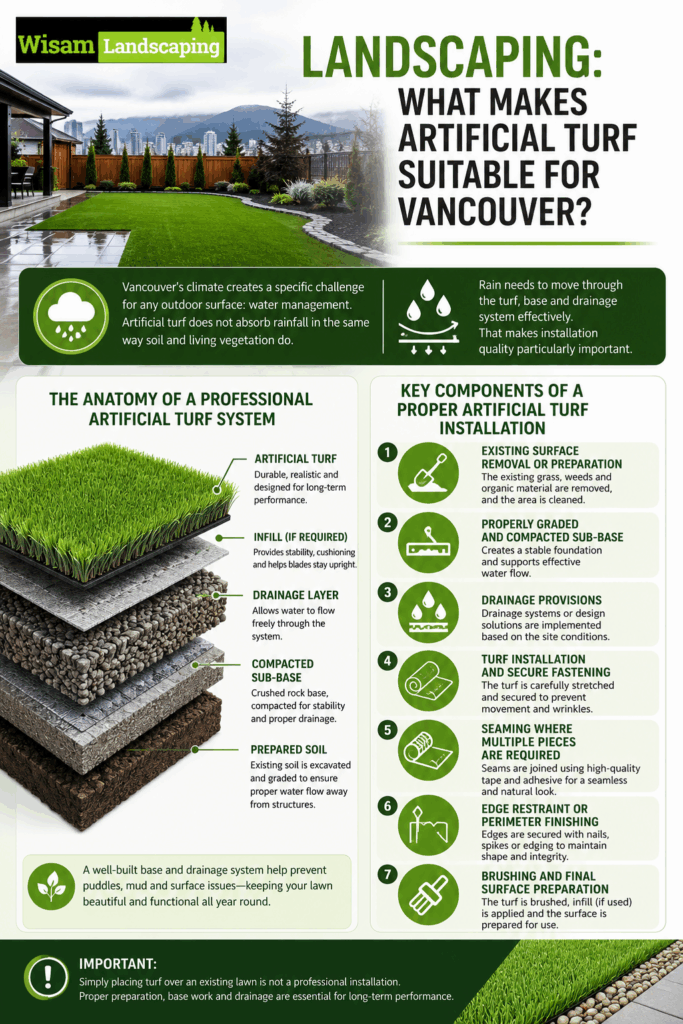
Vancouver’s climate creates a specific challenge for any outdoor surface: water management.
Artificial turf does not absorb rainfall in the same way soil and living vegetation do. Instead, rain needs to move through the turf, base and drainage system effectively.
That makes installation quality particularly important.
A properly designed synthetic turf system generally involves several components, including:
Simply placing turf over an existing lawn is not a professional installation method.
A homeowner may initially focus on how green the finished lawn will look. An experienced installer should be equally interested in what happens underneath it.
Consider a Vancouver backyard that already develops puddles after heavy rain. Installing a new surface without addressing the underlying drainage issue could simply hide the problem temporarily.
Before installation, look at:
The goal is not merely to create an attractive surface. It is to create one that performs appropriately under local conditions.
One of the strongest reasons homeowners investigate artificial turf is the potential reduction in lawn irrigation.
Vancouver has recurring seasonal watering restrictions, and the current 2026 restrictions demonstrate how significant outdoor water conservation can become. The City explains that summer water demand is driven largely by lawn watering, plant irrigation and other outdoor uses.
Unlike natural grass, synthetic turf does not need routine irrigation to remain green.
That can make it attractive for homeowners who want to reduce the amount of potable water used for lawn maintenance.
However, it is important to be precise.
Artificial grass can reduce routine irrigation demand, but that does not mean every artificial lawn is automatically an environmentally superior landscaping choice.
Cleaning, occasional rinsing, site preparation, material production, disposal and stormwater management still matter.
A responsible approach considers the entire installation rather than looking at water use alone.
The term “eco-friendly” is sometimes used too broadly when discussing synthetic turf.
A synthetic lawn can provide water-saving and maintenance advantages, but it also replaces living vegetation. That can affect biodiversity, soil functions, habitat and heat characteristics.
A 2025 UBC Sustainability Scholars report prepared for the City of Vancouver specifically examined artificial turf on private properties and identified considerations involving rainwater, urban heat, biodiversity and potential pollution.
This is why a thoughtful landscaping plan does not necessarily mean replacing every natural planting area with artificial turf.
A more balanced approach might be:
This type of mixed landscape can provide the functional advantages of synthetic turf without turning the entire property into an artificial surface.
Rain management deserves particular attention in Vancouver.
The City has specific concerns around permeable surfaces. For example, artificial turf is not permitted on City property boulevards because it does not have fully permeable characteristics.
That does not mean artificial grass cannot be used on private residential properties. It does mean homeowners should understand that surface drainage and local site conditions matter.
Before an installation, ask how rainfall will move through the proposed turf system and where excess water will go.
That question is more useful than simply asking whether the turf itself is “waterproof.”
Artificial grass can be particularly useful in areas where natural lawn repeatedly struggles.
Heavy shade can make maintaining dense natural grass difficult. If a yard receives limited sunlight, homeowners may find themselves repeatedly reseeding or repairing thin patches.
Synthetic turf is not dependent on sunlight in the same way living grass is.
Families with children may find that heavily used sections of natural lawn become worn, muddy or uneven.
A properly installed synthetic surface can provide a more consistent area for everyday outdoor use.
Small Vancouver properties can make lawn maintenance feel disproportionately time-consuming.
If the lawn is only a modest portion of the property, homeowners may prefer to use that space for seating, play or entertaining rather than spending weekends mowing it.
Sloped, awkwardly shaped or frequently accessed areas can be frustrating to maintain naturally.
The key is to determine whether synthetic turf actually solves the underlying problem rather than installing it simply because it is fashionable.
Pet use is one of the most common reasons homeowners consider synthetic turf.
Dogs can quickly turn natural lawns into muddy areas, particularly during wet weather. Artificial turf can provide a cleaner, more consistent surface for pets.
But not every synthetic turf installation should automatically be described as “pet-friendly.”
For a dog-friendly installation, consider:
Pet waste also needs to be removed promptly. Solid waste should be picked up as it would be on a natural lawn, while urine areas may require periodic rinsing according to the turf manufacturer’s recommendations.
Imagine a homeowner with two dogs whose backyard becomes muddy every winter.
The problem isn’t necessarily that the lawn is poor quality. Repeated foot and paw traffic combined with wet conditions can damage living grass.
In this situation, artificial turf may provide a more practical surface for the high-use section.
However, the homeowner could still retain natural planting areas around the perimeter, creating a more balanced yard.
That is often a better design than simply covering the entire backyard in synthetic material.
The backyard is increasingly treated as an extension of the home.
Homeowners may use outdoor spaces for:
Artificial turf can contribute to this type of Outdoor Living design by providing a consistently neat surface around patios, seating areas or play spaces.
For example, a backyard could combine:
Patio + artificial turf + planting beds + trees + seating + lighting
This creates different functional zones instead of one uninterrupted lawn.
The result can feel more intentional and require less routine lawn maintenance.
The quality of the finished lawn is not determined only by the turf product.
The installation system matters just as much.
During Synthetic Turf Installation in Vancouver, the installer should consider the existing ground, drainage, base material, grading, edges and expected use.
A stable, properly prepared base helps reduce movement, uneven areas and premature wear.
The exact construction method varies according to the site, but the principle is consistent: the surface beneath the turf needs to be engineered for the intended use.
Water needs somewhere to go.
Poor grading can contribute to standing water regardless of how expensive the turf itself is.
Where multiple turf sections meet, seams should be properly aligned and secured.
Visible or poorly finished seams can significantly affect the appearance of an otherwise high-quality installation.
Perimeters should be secured appropriately so the turf does not shift, lift or develop an untidy edge.
Edges are particularly important around pathways, patios, garden beds and areas exposed to frequent foot traffic.
The biggest advantage for many homeowners is not simply appearance. It is predictability.
Natural lawns can change considerably with weather and seasonal conditions.
Artificial grass can provide:
That can be particularly valuable for homeowners who travel frequently, have busy schedules or simply do not want lawn care to be a major weekend task.
But “low maintenance” does not mean “zero maintenance.”
Artificial turf should still be kept free of leaves, debris and weeds around the perimeter. It may require occasional brushing and cleaning, especially in areas with pets or heavy use.
The cheapest installation may not provide the best long-term value.
Ask what is included in the price, particularly when comparing base preparation, drainage work, edge restraints, seams and cleanup.
If your current lawn floods, identify why before installing turf.
A synthetic surface cannot magically correct every underlying drainage issue.
Not every part of a yard needs to become artificial.
Consider where turf provides the most practical value and retain natural planting where it contributes shade, biodiversity or visual interest.
A sample can look great in a showroom and perform poorly for a high-traffic backyard.
Consider the intended use, fibre construction, durability, drainage characteristics and maintenance requirements.
Pet applications require additional consideration around drainage, cleaning, odour and surface performance.
Tell the installer how the area will be used before selecting the product.
Before committing to a project, ask an installer:
A contractor who can answer these questions clearly is giving you much more useful information than someone who focuses entirely on how quickly the lawn can be installed.
No—and that is worth stating clearly.
Artificial turf can be an excellent solution for certain properties, but homeowners should consider both its strengths and limitations.
It may be worth considering if you want:
You may want to explore alternatives if your primary goal is:
In many cases, the best landscaping design is a combination of surfaces rather than choosing one material for the entire property.
Artificial grass can look deceptively simple.
From a distance, it appears to be a roll of material laid across the ground. In reality, the long-term result depends on what happens underneath and around it.
Professional installation can help address:
For Vancouver properties, those details become particularly important because rainfall and drainage conditions can vary significantly from one site to another.
A properly installed lawn should not just look good on installation day. It should be designed around how the property will be used over time.
The strongest artificial turf projects are not isolated product installations. They are part of a broader landscape design.
Think about what happens beyond the turf.
Could a planting bed create a softer transition between artificial grass and a fence? Could a tree provide shade? Could a rain garden manage runoff? Could a patio create a dedicated entertaining area?
These decisions can turn a simple lawn replacement into a more functional outdoor environment.
For homeowners considering Artificial Grass Installation Vancouver, the best question may therefore not be “Should I replace my lawn?”
Instead, ask:
“What should this part of my property do for me?”
Once the purpose is clear, choosing the right surface becomes much easier.
The growing interest in artificial grass among Vancouver homeowners is understandable. Water restrictions, maintenance demands, pet use, heavy traffic and the desire for more usable outdoor space can all make synthetic turf an attractive option.
The Benefits of Artificial Grass can include reduced routine watering, less mowing, fewer muddy areas and a consistently usable surface.
But the best results come from looking beyond the turf itself.
Good drainage, proper base preparation, appropriate product selection and thoughtful landscape design all matter. Just as importantly, homeowners should consider environmental trade-offs rather than assuming synthetic turf is automatically the most sustainable choice.
For some Vancouver properties, artificial grass may be the practical answer. For others, a combination of natural planting, permeable surfaces and targeted synthetic turf may make more sense.
Wisam Landscaping can help homeowners evaluate those considerations as part of a property-specific landscaping approach. The goal should be more than a green-looking lawn—it should be an outdoor space that performs well, fits your lifestyle and makes sense for the property.
It can be, provided the installation is designed around the site’s drainage conditions. Vancouver receives substantial rainfall, so the important issue is not simply whether the turf can get wet. The underlying base, grading and drainage system need to allow water to move away appropriately.
If an existing yard already has pooling problems, those should be investigated before installation. A professional assessment can determine whether grading, base preparation or additional drainage measures are needed.
Artificial grass does not require routine irrigation to stay green, so it can substantially reduce the water normally used for lawn watering. The actual saving depends on the size of the lawn, irrigation habits and local conditions.
Vancouver’s seasonal restrictions make this particularly relevant. As of July 16, 2026, Stage 2 restrictions prohibit residential lawn watering.
However, homeowners should not treat water reduction as the only environmental consideration. Material production, disposal, stormwater behaviour and biodiversity should also be considered when comparing landscaping options.
Artificial turf can work well for dog areas, but the product and installation need to be selected for that purpose. Drainage, cleaning, odour management, durability and surface temperature all deserve attention.
Pet owners should remove solid waste promptly and follow the manufacturer’s cleaning recommendations. During the consultation, explain how many pets will use the area and how frequently so the installer can recommend an appropriate system.
Yes, although the maintenance is generally different from maintaining natural grass.
You may still need to remove leaves and debris, clean areas used by pets, address weeds around the perimeter and periodically brush the fibres to maintain their appearance.
The major difference is that you eliminate many routine lawn-care tasks such as mowing and regular irrigation. That makes artificial grass lower maintenance, not completely maintenance-free.
It is more accurate to say that artificial grass has specific environmental advantages and disadvantages.
Its potential advantages include reduced lawn irrigation and less reliance on mowing equipment. However, artificial turf also replaces living vegetation and can affect biodiversity, heat and rainwater behaviour.
A UBC report prepared for the City of Vancouver examined these issues on private properties, including potential impacts related to runoff, urban heat and biodiversity.
For that reason, a mixed landscape can sometimes be a better solution: use artificial turf where durability and low maintenance are particularly valuable while retaining trees, planting beds and other natural features elsewhere.