

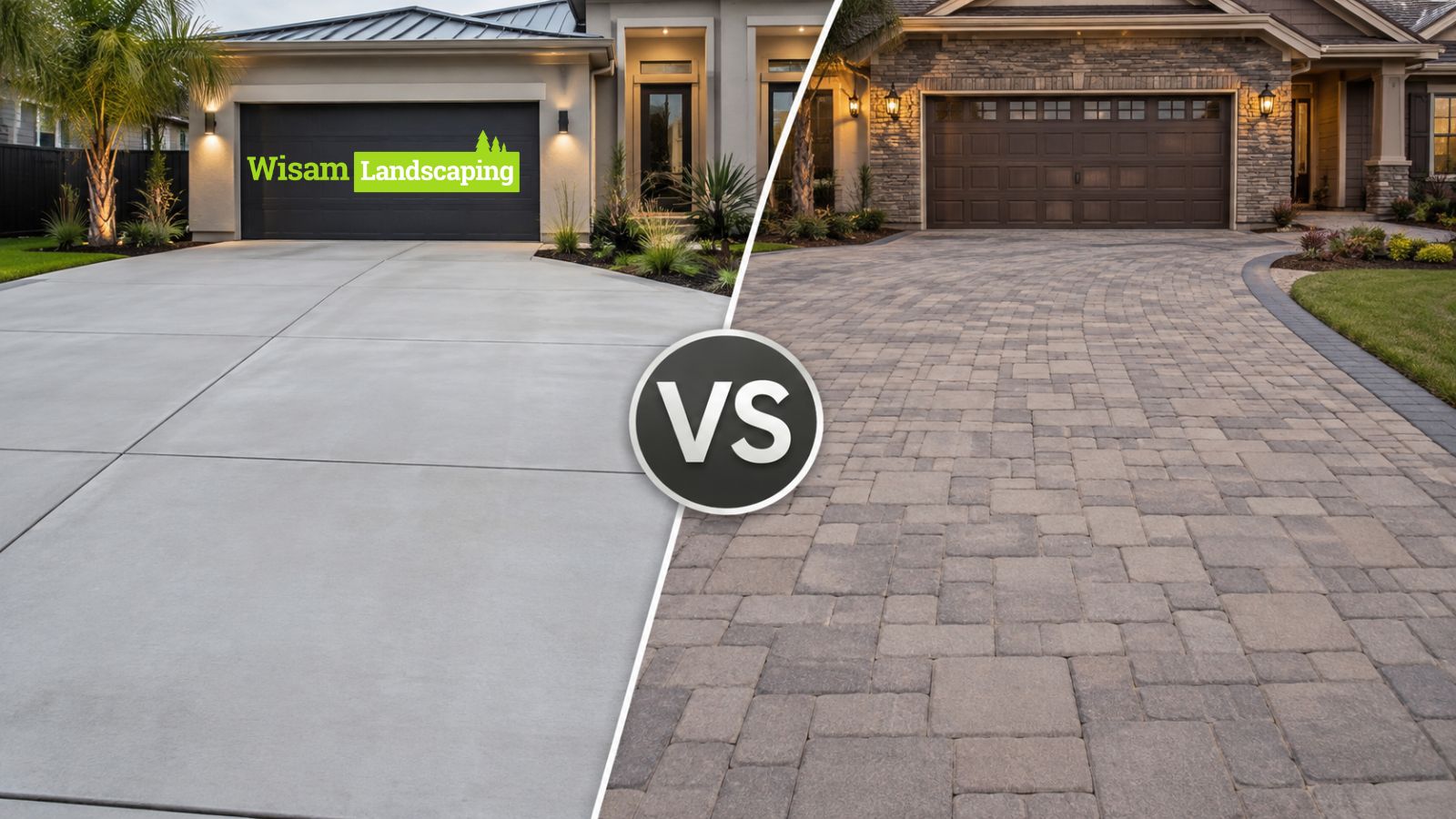
Choosing a new driveway is about more than deciding between two attractive surface materials. In Vancouver, homeowners also need to think about rainfall, drainage, soil conditions, vehicle loads, maintenance, appearance, and how easily the surface can be repaired years later. Concrete Driveway Installation in Vancouver projects can provide a clean, durable surface, while pavers offer flexibility in design and individual-unit replacement. The right choice depends on how your property is used, how it handles water, and what you expect from the driveway over its lifespan.
A driveway is one of the most heavily used hardscape areas around many homes. It needs to withstand repeated vehicle traffic, parking loads, seasonal weather, water movement, and everyday wear while still complementing the house and surrounding landscape. A driveway that looks excellent immediately after installation can still perform poorly if the base, grading, drainage, or material selection is not suited to the property.
Vancouver’s wet climate makes water management particularly important. The City of Vancouver notes that rainwater collected on concrete and other paved surfaces should be managed on the same property rather than directed towards neighbouring properties. The city also identifies increasingly intense rainfall as an important consideration for local infrastructure and drainage planning.
That means homeowners should evaluate the entire driveway system rather than focusing only on the visible surface. A successful Driveway Installation starts below the finished material, with appropriate excavation, subgrade preparation, aggregate base, compaction, grading, and drainage planning.
A Concrete Driveway is a popular option for homeowners who want a relatively uniform surface with a straightforward architectural appearance. Properly designed and installed concrete can handle normal residential vehicle traffic effectively, while its continuous surface creates a clean transition between the garage, front entrance, and surrounding landscape.
One of concrete’s major advantages is design flexibility. Homeowners are not limited to plain grey slabs. Decorative Concrete techniques can introduce exposed aggregate, integral colour, borders, textures, or patterns that give the driveway more visual character. The finish should still be selected with long-term maintenance in mind, particularly in areas that receive frequent rain and organic debris.
However, concrete is not maintenance-free. Cracks can develop when the underlying conditions, jointing, drainage, installation practices, or environmental stresses are not adequately addressed. A professional installation should therefore include suitable control joints and careful attention to the supporting base rather than treating the concrete slab as an isolated product.
Concrete can be a particularly sensible choice when a homeowner wants a visually consistent driveway with relatively low routine maintenance. It can also work well with modern homes, minimalist landscaping, contemporary architecture, and properties where a simple surface helps the building remain the visual focus.
The surrounding Hardscaping also matters. A concrete driveway can be paired with natural stone steps, retaining walls, planting beds, timber elements, or contrasting walkway materials. Good driveway design is not simply about selecting a material; it is about making the surface work with the entire front-yard composition.
A Paver Driveway uses individual paving units installed over a prepared base and bedding layer. The modular nature of the system creates a significant difference from a continuous concrete slab. If a small section becomes damaged or needs to be removed for access to an underground utility, individual pavers can generally be lifted and reinstalled rather than cutting out an entire slab.
This repairability is one reason homeowners consider Paver Driveway Installation Vancouver projects when planning a long-term landscape improvement. Pavers can also create a more textured, architectural appearance, particularly when different sizes, laying patterns, borders, and complementary colours are combined thoughtfully.
Interlocking systems can accommodate some minor movement through the joints between units. That does not mean pavers cannot settle or develop problems. Poor excavation, inadequate base preparation, insufficient compaction, improper edge restraint, or drainage problems can still cause uneven areas. The modular surface makes repairs easier, but it does not eliminate the need for proper construction.
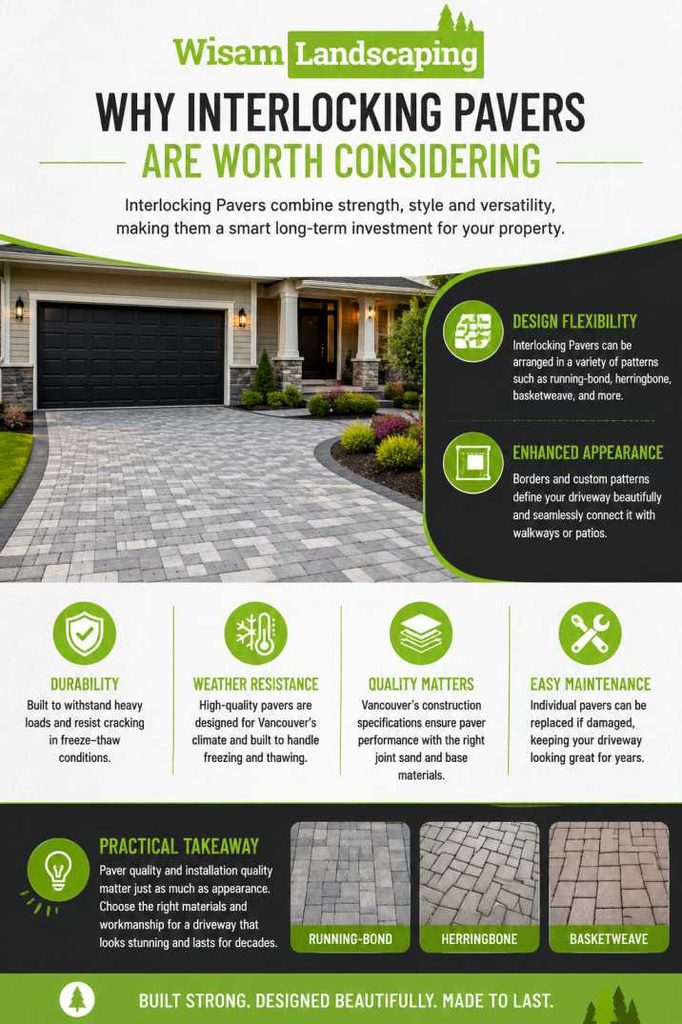
Interlocking Pavers are particularly useful when design flexibility is a priority. They can be arranged in running-bond, herringbone, basketweave, or other patterns, depending on the product and project requirements. Borders can also be used to define the driveway visually and connect it with adjacent walkways or patios.
Vancouver’s construction specifications for unit paving include requirements related to concrete paver performance, including resistance to freezing and thawing, as well as requirements for joint sand and base materials.
For homeowners, the practical lesson is straightforward: paver quality and installation quality matter just as much as appearance.
When comparing Concrete vs Paver Driveways, there is no universal winner. Each system has advantages that become more or less important depending on the property.
| Factor | Concrete | Pavers |
|---|---|---|
| Appearance | Clean and continuous | Textured and highly customisable |
| Design | Good with decorative finishes | Excellent pattern and colour flexibility |
| Repairs | Damaged areas may require cutting and patching | Individual units can often be replaced |
| Maintenance | Generally straightforward | Joints require periodic attention |
| Drainage options | Depends heavily on grading and design | Permeable systems may be possible |
| Movement | Cracks can occur if stresses are not managed | Individual units can shift if base preparation is poor |
| Overall style | Modern, simple, uniform | Traditional, contemporary, or detailed |
| Long-term planning | Focus on slab, joints and drainage | Focus on base, joints, restraints and drainage |
The table illustrates why material selection should follow the property’s requirements rather than simply the homeowner’s initial preference.
One of the most overlooked aspects of driveway construction is what happens to rainfall after it reaches the surface. A driveway may be beautifully finished, but poor grading can result in standing water, runoff towards buildings, or drainage problems around neighbouring properties.
The City of Vancouver specifically recognises permeable pavement as one potential rainwater-management approach. Its engineering guidance identifies permeable pavements, including certain interlocking paver systems and porous concrete, as options that can reduce impervious area and promote infiltration where appropriate.
This does not mean every driveway should automatically be permeable. Soil characteristics, slope, site constraints, groundwater conditions, structural requirements, and applicable regulations all need to be considered. The important point is that drainage should be part of the initial Paving and site-planning conversation, not something addressed after water begins pooling.
Good Driveway Design starts with the property rather than the paving catalogue. Consider the architectural style of the home, rooflines, exterior colours, garden structure, fencing, walkways, retaining walls, and existing hardscape.
For example, a contemporary home may suit large-format concrete with crisp edges and restrained landscaping. A traditional property might benefit from patterned pavers with a contrasting border. A heavily landscaped front yard may require a simpler driveway so the planting remains the dominant feature.
Scale is also important. A small frontage can look crowded when too many paving patterns, colours, borders, and decorative elements are combined. Conversely, a large driveway can sometimes benefit from subtle pattern changes that visually break up an expansive surface.
The driveway should not be designed in isolation from other hardscape elements. Hardscape Construction may include walkways, steps, retaining walls, patios, edging, drainage features, and garden borders. When these elements share complementary materials or design details, the front yard tends to feel more cohesive.
For instance, pavers used around a driveway border can be repeated along a front walkway. Alternatively, a concrete driveway can be visually connected to the home through a matching concrete path or contrasting stone edging. These details may seem minor during planning, but they often have a major influence on the finished appearance.
Regardless of the selected material, the installation process is critical. A typical driveway project starts with measuring and layout, followed by excavation to the required depth. Unsuitable soil or organic material may need to be removed before the structural base is installed.
The base material must be placed and compacted appropriately. Grading is then established so water moves towards its intended drainage location. The final surface is installed only after the underlying structure is ready.
For concrete, this includes forming, reinforcement where specified, concrete placement, finishing, and jointing. For pavers, the process generally involves base preparation, bedding material, edge restraints, paver placement, joint filling, and final compaction. Skipping or rushing these stages can compromise an otherwise high-quality material.
A low initial quote does not necessarily represent the lowest long-term cost. Ask what excavation depth, base preparation, drainage work, edge restraints, jointing materials, finishing, and cleanup are included. Two contractors may quote for the same square footage while proposing very different construction systems.
Water is one of the most important factors in driveway performance. If the finished surface does not have an appropriate drainage strategy, even premium materials can develop problems. Homeowners should ask where rainwater will go and how the proposed grading interacts with the house, garage, sidewalk, and property boundaries.
Two homes on the same street can have different subgrade conditions. Existing fill, soft areas, roots, previous construction, and local soil characteristics can influence how much preparation is required. A contractor who identifies these conditions before installation can make better decisions about excavation and base construction.
Think about future utility work before committing to a driveway system. Pavers can offer a practical advantage where individual units can potentially be removed and reinstated. Concrete can still be appropriate, but future cutting and patching should be considered during planning.
Start by defining how the driveway will actually be used. A property with one passenger vehicle and generous landscaping requirements may have different priorities from a household regularly parking multiple vehicles, trailers, or heavier equipment.
Next, consider maintenance preferences. If you prefer a visually uniform surface and straightforward cleaning, concrete may appeal to you. If repairability, pattern selection, and modular construction are higher priorities, pavers may deserve closer consideration.
Finally, do not overlook the surrounding site. The best material on paper may not be the best choice once slope, drainage, soil, vehicle access, landscaping, and property layout are considered. A site-specific assessment is more valuable than choosing a material based solely on photographs or general online comparisons.
The answer ultimately depends on your priorities. Concrete can provide a durable, clean-looking surface with strong design potential through Decorative Concrete finishes. Pavers provide extensive visual flexibility and the practical advantage of individual-unit replacement. Both can perform well when the design, materials, drainage, base preparation, and installation are appropriate for the site.
For Vancouver homeowners, water management deserves particular attention. The city’s current guidance emphasises managing surface water on private property and provides resources for permeable pavement and other rainwater-management approaches.
The best driveway is not necessarily the most expensive, most decorative, or most popular option. It is the system that fits the home’s architecture, site conditions, drainage requirements, traffic demands, maintenance expectations, and long-term plans. Concrete vs Paver Driveways should therefore be treated as a property-specific decision rather than a simple competition between two materials.
For homeowners considering Concrete Driveway Installation Vancouver projects or exploring Paver Driveway Installation in Vancouver, a careful site assessment is a sensible first step. Wisam Landscaping can help homeowners evaluate practical considerations such as layout, material selection, drainage, and surrounding hardscape so the final driveway supports both everyday function and the overall appearance of the property.
Neither material is automatically better simply because Vancouver receives substantial rainfall. The drainage strategy, grading, base preparation, and site conditions are more important than the surface material alone. Concrete can perform well when correctly graded and installed, while suitable permeable paver systems can offer additional rainwater-management opportunities. The correct choice should be based on the property’s soil, slope, drainage requirements, vehicle use, and applicable local requirements.
Pavers can require attention to joint sand, weeds, moss, and occasional movement between units, particularly in a damp environment. However, their modular construction can make certain repairs easier. Concrete generally has fewer individual components to maintain, but cracks or significant surface damage can require more visible repair work. The better choice depends on whether you value simpler routine maintenance or easier access to individual damaged sections.
The base is fundamental to both systems. A beautiful surface installed over poorly prepared ground can settle, crack, shift, or drain poorly. Proper excavation, suitable aggregate, moisture control, grading, and compaction help create a stable foundation. The required construction approach varies with soil conditions, loading, climate, and the selected paving system, so a contractor should evaluate the actual site rather than applying one depth or specification to every property.
They can offer environmental advantages in the right application, particularly when a permeable paver system is appropriately designed for the site. The City of Vancouver identifies permeable pavers among green rainwater infrastructure options because gaps can allow water to infiltrate rather than sending all surface runoff directly into conventional drainage systems. However, permeability is not automatically beneficial on every property; soil and drainage conditions need to support the proposed system.
Ask how the contractor will assess the existing soil, how much excavation is anticipated, what base materials will be used, how the base will be compacted, and where surface water will be directed. Also ask about control joints for concrete or edge restraints and jointing for pavers, depending on the chosen system. A reputable professional should be able to explain the proposed construction process in understandable terms rather than simply presenting a price.