

Choosing artificial grass for a residential property involves more than selecting the greenest or softest product available. Homeowners need to consider how the lawn will be used, how much traffic it will receive, whether pets will use it, how much sunlight reaches the area, and how effectively rainwater can drain through the surface. For homeowners considering Artificial Grass Installation Vancouver, these factors can make a significant difference to long-term performance. The Best Artificial Grass for Homes is the product that suits the property’s conditions, lifestyle, appearance preferences, and maintenance expectations rather than simply the most expensive option.
Artificial grass has developed considerably over the years. Modern products can include different blade shapes, colour variations, densities, backing systems, and textures designed to create a more natural lawn appearance.
For residential landscaping, artificial turf can be useful where homeowners want a consistently green surface without the regular mowing, watering, fertilising, and weed control associated with natural grass.
However, artificial turf is not one-size-fits-all. A small decorative front lawn has different requirements from a backyard used by children every day. Similarly, a household with two dogs needs to think about drainage and cleaning differently from a household where the lawn is mainly used for occasional outdoor entertaining.
Before choosing a product, homeowners should consider:
Considering these factors together makes it easier to choose a product that will remain practical and attractive over time.
There is no universal specification that makes one artificial lawn suitable for every residential property. The right product depends on the site and the people using it.
For example, a family with young children may want a comfortable, resilient surface that can handle frequent play. A homeowner with a dog may prioritise drainage and odour management. Someone renovating a front garden may care more about realistic colour variation and appearance.
Blade height affects the overall appearance and feel of synthetic turf. Longer fibres can produce a luxurious appearance, while shorter fibres can provide a more structured and easier-to-maintain surface.
Longer is not automatically better. Very long blades can flatten under regular foot traffic if the product is not designed to recover effectively.
For many residential applications, a moderate blade height can offer a practical balance between softness, visual appeal, and stability.
Turf Density describes how closely the artificial fibres are positioned within the turf. Higher density can create a fuller appearance and may help the lawn recover after repeated use.
However, density should never be considered in isolation. The quality of the fibres, backing, installation base, and drainage system also influence performance.
A dense product installed over an unsuitable base may still develop problems. Conversely, a moderately dense product installed correctly may provide excellent results for a lightly used residential area.
Not every part of a residential property needs the same type of turf. Understanding how each area will be used can prevent homeowners from paying for features they do not actually need.
A backyard used regularly by children, adults, and visitors should have turf capable of handling repeated foot traffic.
Important characteristics can include:
The preparation underneath the turf is equally important. If the base is uneven or unstable, the finished lawn can eventually develop depressions, ripples, or drainage problems.
Front lawns often receive less physical traffic but play an important role in the appearance of the property.
Homeowners may want:
In these situations, visual realism and long-term colour retention may be more important than extreme heavy-duty performance.
Smaller Vancouver properties can benefit from artificial turf because it creates a consistent green surface without requiring extensive lawn maintenance.
However, compact yards can present drainage challenges because there may be fewer natural areas for water to disperse. The installation design should therefore consider the existing slope, soil, surrounding hard surfaces, and drainage routes.
Homeowners often compare turf products by looking at blade height and density first. These are useful specifications, but they should be evaluated together with the intended use.
A residential lawn that receives constant foot traffic needs fibres that can recover after being compressed. Outdoor furniture, children playing, garden equipment, and pets can all create pressure on the surface.
A simple physical sample can reveal useful information.
Press the fibres down with your hand and observe how they respond. Then compare several products side by side.
Consider:
These practical observations can be more informative than relying on a single specification.
Artificial grass remains exposed to sunlight throughout its life. Quality UV Protection is therefore an important consideration for residential installations.
Poor-quality fibres may fade, become brittle, or lose their appearance after prolonged exposure to sunlight.
Different parts of a property can experience very different levels of exposure.
Before choosing turf, homeowners should consider:
A completely exposed lawn may require stronger UV resistance than a heavily shaded area.
Homeowners should ask for manufacturer information and warranty details rather than relying solely on general claims that a product is “UV resistant.”
Drainage is one of the most important considerations when planning artificial turf in a wet climate.
A lawn may look excellent immediately after installation, but poor drainage can eventually lead to standing water, unpleasant odours, surface deterioration, or problems with the underlying base.
The turf surface is only one component of the drainage process.
Water may need to move through:
Every layer needs to work together.
If water cannot move efficiently through the underlying ground, simply choosing a permeable turf product may not resolve the problem.
Before Artificial Grass Installation Vancouver, the existing site should be assessed for slope, soil conditions, drainage, and the condition of the current lawn or surface.
For example, consider a backyard that regularly develops puddles after heavy rainfall. Installing turf directly over the existing surface may hide the problem temporarily but does not necessarily solve it.
Proper grading and base preparation can provide a more reliable long-term solution.
Artificial grass can work well for households with pets, but pet use should be considered before selecting the product.
Pet-Friendly Turf needs to accommodate regular waste removal, cleaning, urine drainage, and repeated movement.
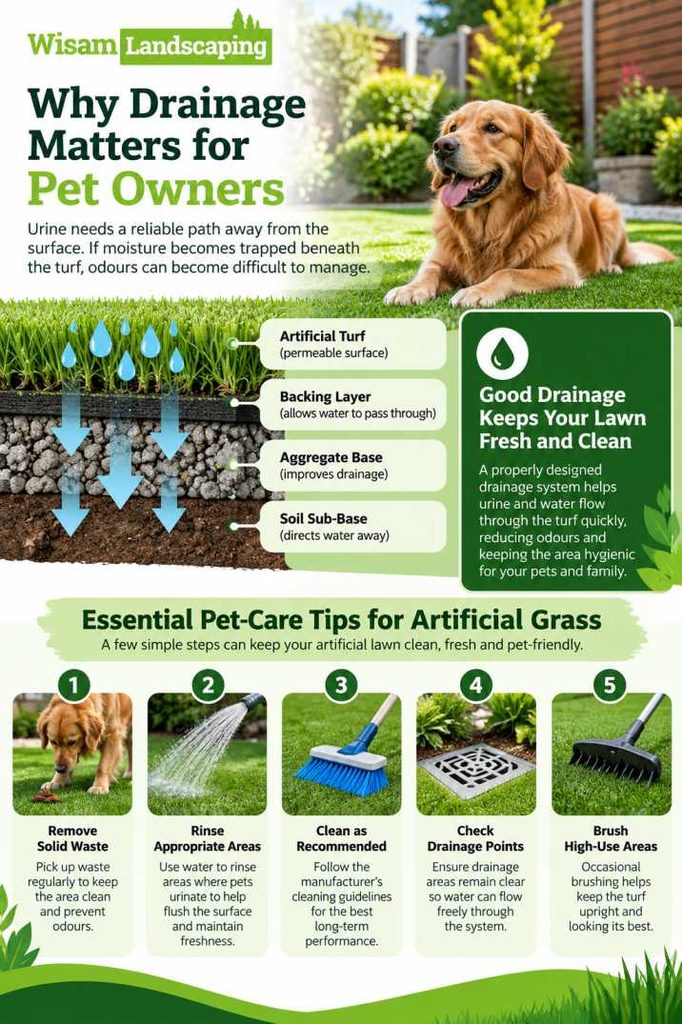
Urine needs a reliable path away from the surface. If moisture becomes trapped beneath the turf, odours can become difficult to manage.
A suitable installation should therefore consider both the turf’s permeability and the drainage conditions underneath it.
Pet owners should also establish a routine for:
Artificial turf can reduce some lawn maintenance, but it does not eliminate the need for responsible pet-area cleaning.
One of the most common mistakes homeowners make is focusing heavily on the visible turf while overlooking the material beneath it.
The installation base contributes significantly to the finished result.
It can affect:
Depending on the existing conditions, preparation may involve removing unsuitable material, establishing an appropriate grade, installing aggregate, compacting the base, and addressing drainage requirements.
The exact process should be determined by the property rather than applying one method to every installation.
A flat, well-drained site may require a different preparation approach from a sloped yard with compacted soil or existing drainage issues.
If the ground underneath settles unevenly, homeowners may eventually notice:
Correcting these issues after installation can be disruptive and expensive. Proper preparation at the beginning is generally a better approach.
Vancouver’s weather creates specific considerations for residential turf projects. Rainfall, seasonal moisture, shade, soil conditions, and changing outdoor temperatures can all influence the performance of a synthetic lawn.
Synthetic Turf Installation Vancouver should therefore be approached as a complete landscaping project rather than simply covering an existing lawn with artificial material.
The installation should account for where rainwater currently travels across the property.
If water naturally moves toward a low point, the turf installation should not unintentionally block or redirect that flow in a way that creates a new problem.
Artificial grass can be useful where natural grass struggles because of limited sunlight. However, shaded areas can remain damp for longer periods.
This makes drainage, surrounding vegetation, and routine cleaning particularly important.
Homeowners should select products designed for outdoor exposure and follow the manufacturer’s maintenance recommendations. Quality installation also helps the turf maintain its appearance as weather conditions change throughout the year.
Photographs can help homeowners understand the general appearance of a product, but physical samples provide much more useful information.
When comparing samples, examine several characteristics.
Natural grass is rarely one uniform shade. Quality artificial turf can use multiple fibre colours to create a more realistic appearance.
Run your hand across the sample. Consider whether the surface is comfortable enough for children or barefoot use if that is important to your household.
Separate the fibres slightly and inspect how much backing is visible. This provides a practical indication of how full the product appears.
Press the fibres down and see how well they return to an upright position.
Ask about the backing material, permeability, intended outdoor use, and warranty.
Find out how the specific turf allows water to pass through and how the installation system will manage that water beneath the surface.
Artificial turf is not automatically the right choice for every property.
Natural grass can remain an excellent option for homeowners who enjoy lawn care, prefer natural vegetation, or have conditions that support healthy grass growth.
Artificial turf may be particularly useful where homeowners want:
The decision should be based on lifestyle, property conditions, maintenance preferences, and budget rather than simply following a landscaping trend.
A low purchase price does not necessarily mean lower total cost over the life of the lawn.
Homeowners should consider product quality, installation requirements, warranty coverage, expected lifespan, maintenance, and potential repair costs.
Longer blades can create a soft, luxurious appearance, but they can also flatten more easily if the product is not designed for heavy use.
Blade height should be matched to the intended application.
This can be particularly problematic in areas that receive significant rainfall.
A permeable turf product cannot compensate for an underlying base that prevents water from moving away effectively.
If dogs will regularly use the lawn, homeowners should specifically investigate drainage, cleaning, backing construction, durability, and odour management.
Artificial turf should not simply be placed over an uneven lawn and expected to remain perfectly flat.
Ground preparation is a major part of the installation process and can have a direct impact on the finished result.
Think about what happens in the space during a normal week.
Do children play there? Do dogs use it? Do guests gather there? Is it primarily decorative? Does outdoor furniture remain on the lawn?
The answers can help determine the appropriate durability, density, texture, and maintenance requirements.
Homeowners sometimes spend considerable time comparing visible turf specifications while overlooking the base.
A stable, appropriately graded and well-prepared foundation can be just as important as the turf itself.
A reputable supplier or installer should be able to explain relevant specifications, including UV resistance, fibre construction, backing, drainage characteristics, warranty conditions, and intended applications.
Avoid making a decision based solely on vague claims such as “premium quality” without supporting information.
Artificial grass usually requires less maintenance than natural turf, but it is not maintenance-free.
Routine care may include removing leaves, cleaning spills, removing pet waste, brushing high-traffic areas, and checking drainage points.
Understanding these responsibilities before installation helps homeowners choose a system that matches their expectations.
A successful artificial lawn should not look disconnected from the rest of the property.
It should work naturally with:
This is where landscaping design becomes important.
For example, a backyard can combine artificial turf with natural planting beds and a paved seating area. The contrast between green turf, plants, stone, and timber can create a more balanced outdoor environment than covering the entire property with one material.
Artificial turf can be a practical investment when it solves a genuine landscaping problem.
For example, a homeowner may have a shaded backyard where natural grass repeatedly becomes thin and muddy. Another property may have a high-traffic lawn that requires constant repair. A household with pets may want a durable outdoor surface that is easier to maintain.
In these situations, artificial turf can provide meaningful practical benefits.
However, homeowners should not assume that every property will benefit equally. A well-maintained natural lawn may remain the better option for someone who enjoys gardening and already has suitable growing conditions.
The best decision comes from comparing the property’s existing conditions with the homeowner’s actual priorities.
For homeowners planning Artificial Grass Installation Vancouver, Wisam Landscaping can help evaluate the factors that influence the suitability of different turf options. The discussion should cover how the space will be used, existing ground conditions, drainage, sunlight, pets, foot traffic, and the appearance the homeowner wants to achieve.
A practical approach focuses on the complete installation rather than treating the turf as an isolated product. Wisam Landscaping can help homeowners consider the relationship between the artificial lawn, ground preparation, drainage, edging, garden areas, and the wider landscape design.
The Best Artificial Grass for Homes is not necessarily the thickest, longest, or most expensive product. It is the product that matches the way the property will actually be used.
Homeowners should evaluate Turf Density, blade height, fibre quality, UV Protection, backing construction, drainage performance, pet requirements, maintenance, and installation conditions before making a decision.
For Vancouver properties, drainage deserves particular attention because rainfall can expose weaknesses in an improperly prepared installation. A high-quality turf product still needs an appropriately designed base and suitable water-management strategy.
The goal should be a residential lawn that looks natural, feels comfortable, handles everyday use, and remains practical to maintain. With careful product selection and professional preparation, artificial turf can become a functional part of a wider landscaping plan rather than simply a replacement for natural grass.
The ideal artificial grass depends on how the backyard will be used. A family with children may prioritise softness, fibre recovery, durability, and drainage, while a household with dogs may place greater emphasis on permeability and odour management.
Homeowners should compare blade height, density, fibre quality, backing, UV resistance, and drainage rather than selecting a product based on appearance alone. The installation environment is equally important because even premium turf can perform poorly over an unsuitable foundation.
Yes. Artificial turf can be suitable for dogs when the product and installation are selected with pet use in mind.
Pet owners should prioritise effective urine drainage, durable fibres, appropriate backing, easy cleaning, and a suitable underlying drainage system. Solid waste should still be removed promptly, and the lawn should be cleaned according to the manufacturer’s recommendations.
For households with multiple dogs, drainage becomes particularly important because repeated urine exposure can create odour issues if moisture does not move efficiently through the installation.
The lifespan varies depending on product quality, installation, sunlight exposure, foot traffic, maintenance, and usage.
High-quality turf designed for outdoor applications can remain functional for many years when installed correctly and maintained appropriately. However, a heavily used family lawn or pet area may experience more wear than a decorative front lawn.
Homeowners should review the specific manufacturer’s warranty and product specifications rather than relying on a generic lifespan estimate.
Yes, drainage should be carefully considered for Vancouver residential installations.
Although many artificial turf products are designed to allow water to pass through, the turf is only one part of the drainage system. The aggregate base, soil, grading, and drainage outlets also determine how effectively water leaves the area.
A professional site assessment can identify existing drainage problems before installation and help determine whether additional measures are required.
No. Artificial turf generally requires considerably less routine maintenance than natural grass, but it still needs care.
Leaves and debris should be removed, pet waste should be collected, spills should be cleaned, and high-traffic areas may occasionally need brushing. Drainage points should also remain clear.
The main advantage is that homeowners can avoid many traditional lawn-care tasks such as regular mowing, fertilising, and routine watering while still maintaining an attractive outdoor surface.