

Vancouver gardens have a particular challenge: beautiful landscapes must also cope with frequent rainfall, damp conditions, changing temperatures, moss growth, and occasional freezing weather. A walkway that looks excellent when installed can become slippery, uneven, or prone to movement if the material and base are poorly suited to the site. Choosing the right surface therefore requires more than comparing colours and textures. This Walkway Material Guide explains the practical differences between natural stone, concrete pavers, and concrete walkways, with a focus on drainage, durability, maintenance, safety, and landscape design. For homeowners considering Stone Walkway Installation Vancouver, understanding these factors can prevent expensive problems later.
Vancouver’s wet climate has a direct effect on hardscaping materials. Rainwater needs somewhere to go, and the ground beneath a walkway must be capable of supporting the surface without excessive movement. Poor drainage can contribute to settlement, algae or moss growth, staining, frost-related movement, and deterioration of joints.
The material itself is only one part of the equation. A professionally constructed walkway depends on several connected components, including excavation depth, sub-base preparation, compaction, bedding material, surface falls, jointing, and edge restraint.
A useful way to think about a garden path is as a small engineered system rather than simply a decorative strip through the garden. Even an expensive stone can perform poorly when installed over an unstable or poorly drained base.
Heavy or persistent rainfall makes drainage particularly important in Vancouver landscapes. A walkway should generally be designed so water does not remain pooled across the walking surface. The surrounding garden should also be considered because water from slopes, downspouts, lawns, or planting areas may flow toward the path.
During site planning, experienced landscapers look at the existing grade rather than simply deciding where the path should appear visually. In some gardens, adjusting the grade or incorporating drainage solutions is more important than selecting a premium paving material.
This is one reason Walkway Installation Vancouver projects benefit from proper site assessment before materials are ordered. The same stone or paver can behave very differently depending on the soil, slope, drainage conditions, and expected foot traffic.
Natural Stone remains a popular option for homeowners who want a garden walkway with variation and an organic appearance. Materials such as flagstone, slate, bluestone, and other natural stones can complement planting beds, retaining walls, timber features, and naturalistic gardens.
One of the major advantages of natural stone is its visual variation. Individual pieces can have differences in colour, grain, texture, and edge shape. Rather than producing a uniform appearance, these variations can make the walkway feel integrated with the landscape.
Natural stone can work particularly well where the walkway is intended to be a design feature rather than simply a route from one location to another. A winding flagstone path through planting beds, for example, can create a softer transition between a patio and a garden area.
Not every natural stone product is equally suitable for a wet outdoor environment. Surface texture, thickness, porosity, installation method, and intended use should all be considered.
For a frequently used walkway, look for stone with an appropriate surface texture and adequate durability. Highly polished surfaces may be attractive in some applications but can be unsuitable where regular exposure to rain creates a higher slip risk.
It is also important to consider the shape and thickness of individual pieces. Very irregular pieces may require more careful installation to achieve a comfortable walking surface. Large slabs can look impressive but need adequate support underneath to reduce the risk of cracking or movement.
Concrete Pavers provide another practical option for Vancouver gardens. They are manufactured in consistent shapes and sizes, making it easier to create defined patterns and clean edges. Modern pavers are available in many colours, textures, dimensions, and surface finishes.
One useful characteristic of individual pavers is that the walkway can be repaired in sections. If a small area settles or becomes damaged, individual units may be lifted and replaced rather than removing an entire continuous slab.
Concrete pavers can also support different styles of Landscape Design. Larger-format units can create a contemporary appearance, while smaller rectangular or textured pavers can work with traditional gardens.
The joints between pavers are an important part of the overall installation. They help individual units work together and contribute to the stability of the finished surface.
However, joints can also become places where weeds, organic debris, or moss develop, particularly when they remain damp and receive limited sunlight. Good drainage, suitable jointing material, regular sweeping, and sensible maintenance can help manage these issues.
Another consideration is edge restraint. Without adequate restraint, pavers may gradually spread or shift toward the garden edges. This can create gaps, uneven lines, and a less stable walking surface.
A Concrete Walkway can provide a relatively uniform surface and suits homeowners who prefer clean lines and minimal visual variation. It can also be shaped to follow straight or gently curved routes through a garden.
Concrete offers considerable design flexibility through different finishes, textures, colours, and patterns. However, a poured concrete walkway behaves differently from individual pavers. If cracking or settlement occurs, repairs may be more noticeable because the surface is continuous.
The base preparation remains critical. Concrete placed over poorly compacted or unstable ground may crack or settle even when the concrete itself is appropriately mixed and finished.
For this reason, material selection should never be separated from installation quality. A lower-cost material installed on a properly prepared base can sometimes outperform a premium product installed incorrectly.
Slip Resistance deserves particular attention in Vancouver because wet surfaces are a regular part of outdoor life. A walkway can become more hazardous when rain, organic debris, algae, or moss accumulate on the surface.
Material selection should therefore consider texture rather than appearance alone. Smooth, highly polished finishes may provide less traction when wet. Textured natural stone, suitable paver finishes, and appropriately finished concrete can provide better grip depending on the specific product.
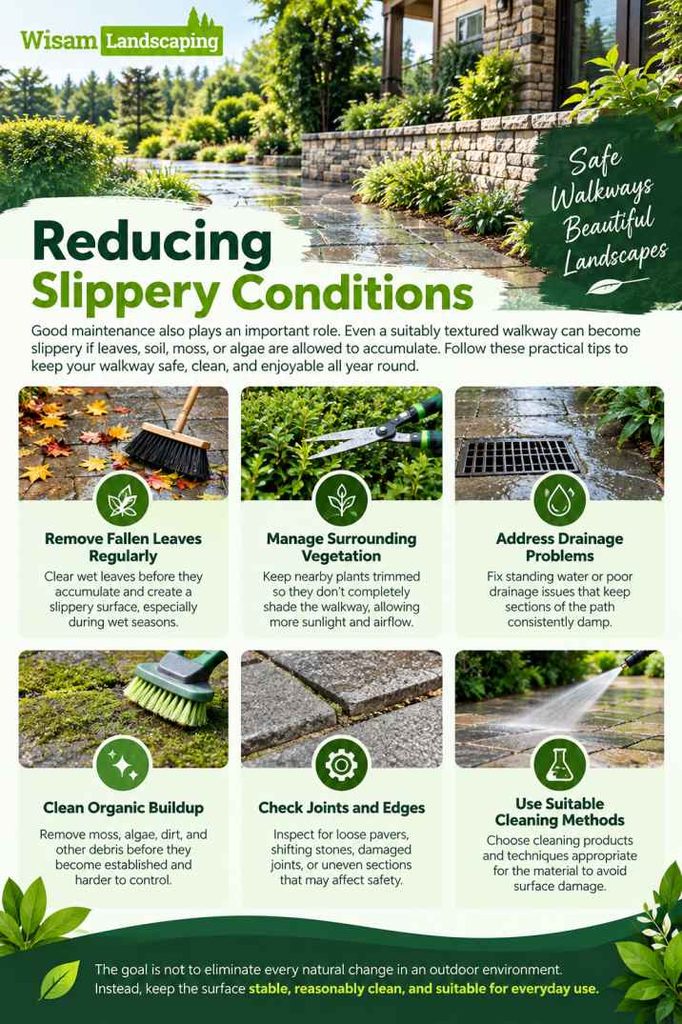
Good maintenance also plays an important role. Even a suitably textured walkway can become slippery if leaves, soil, moss, or algae are allowed to accumulate.
Practical maintenance includes:
The objective is not to eliminate every natural change in an outdoor environment. Instead, the goal is to keep the surface stable, reasonably clean, and suitable for everyday use.
A walkway should make sense within the wider landscape rather than appearing as an isolated feature. Its material, width, shape, colour, and edge treatment should relate to the house, garden beds, fencing, patios, steps, and other hardscaping elements.
For example, a contemporary home may suit large-format concrete pavers with simple lines, while a cottage-style garden could benefit from irregular natural stone surrounded by softer planting.
The route matters just as much as the material. A path that follows the natural movement of people through the garden is more useful than one designed solely for appearance. Think about where people actually walk, where outdoor equipment needs to pass, and whether the path connects important areas such as the driveway, entrance, patio, shed, or backyard.
The visible surface often receives most of the attention, but the hidden foundation is one of the biggest factors affecting long-term performance.
A typical installation may involve removing unsuitable soil, establishing the correct grade, preparing a compacted granular base, adding appropriate bedding material, placing the selected surface, and securing the edges.
The exact construction depends on site conditions and material specifications. Clay-heavy soil, soft ground, slopes, tree roots, existing drainage problems, and areas exposed to vehicle loads can all require different preparation.
Insufficient compaction is a common reason for settlement. When loose material beneath a walkway compresses after installation, the surface above it can sink or become uneven.
This is particularly noticeable after periods of heavy rain because water can move through or saturate poorly prepared areas. A well-designed base distributes loads and provides a more stable platform for the finished surface.
Edges deserve attention because they receive repeated lateral pressure from foot traffic, garden maintenance, and weather. Suitable edging or restraint helps keep pavers and stones in their intended position.
Transitions also need careful planning. Where a garden path meets a driveway, patio, lawn, steps, or entrance, the height difference should be considered. A poorly planned transition can create a trip hazard or allow water to collect.
| Material | Appearance | Maintenance | Repairability | Vancouver Considerations |
|---|---|---|---|---|
| Natural Stone | Organic and varied | Moderate | Individual pieces may be replaceable | Texture and drainage are important |
| Concrete Pavers | Consistent and versatile | Moderate | Individual units can often be replaced | Joint and edge maintenance matter |
| Concrete Walkway | Clean and uniform | Moderate | Repairs can be more visible | Base preparation and drainage are critical |
This Walkway Material Guide shows why there is no single material that suits every garden. The best choice depends on the property’s soil, drainage, architectural style, foot traffic, maintenance expectations, budget, and desired appearance.
One of the most common mistakes is choosing a material based entirely on appearance. A sample may look perfect in a showroom but perform differently outdoors when exposed to rain, shade, organic debris, and temperature changes.
Another mistake is underestimating preparation. Homeowners sometimes focus heavily on the visible stone or pavers while treating excavation and base construction as secondary details.
Other issues worth avoiding include:
These mistakes can often be prevented during planning rather than corrected after installation.
Start by identifying how the walkway will actually be used. A decorative garden path used occasionally has different requirements from a main entrance route used every day.
Next, inspect the site during or shortly after rainfall if possible. Look for areas where water naturally collects, drains slowly, or flows toward the proposed path. This can reveal problems that may not be obvious during dry weather.
It is also worth viewing material samples outdoors. Natural light can change how colours appear, while wet surfaces can look considerably different from dry ones.
Finally, consider future maintenance. Ask how easily the material can be cleaned, whether individual units can be replaced, how joints will be maintained, and whether nearby trees or plants could create ongoing issues.
The best garden walkway is not necessarily the most expensive one. It is the material and installation system that suits the property’s conditions and the homeowner’s practical needs.
For some Vancouver properties, natural stone provides the right balance of character and durability. For others, concrete pavers offer easier pattern control and repairability. A poured concrete surface may be appropriate where a continuous, clean finish is preferred.
For homeowners researching Stone Walkway Installation Vancouver, the important question is therefore not simply, “Which material looks best?” A better question is, “Which material, surface finish, and installation method will work reliably on this specific property?”
A successful garden path should look natural within the landscape while remaining stable, comfortable, safe, and practical in Vancouver’s changing weather. Material selection is important, but drainage, foundation preparation, surface texture, edge restraint, and ongoing maintenance have an equally significant role.
Use this Walkway Material Guide as a starting point rather than a substitute for assessing your individual property. If you’re planning Stone Walkway Installation Vancouver, Wisam Landscaping can help evaluate the landscape conditions, discuss suitable material options, and develop a walkway approach that complements the property’s existing design without relying on a one-size-fits-all solution.
There is no universal best material because site conditions vary. Natural stone, concrete pavers, and concrete can all work when correctly selected and installed. Drainage, surface texture, soil stability, foot traffic, maintenance expectations, and the surrounding landscape should guide the decision. A walkway exposed to frequent rain should receive particular attention to water management and Slip Resistance, regardless of which surface material is selected.
Natural stone can be suitable for Vancouver, but the specific stone and finish matter. A textured surface can provide better traction than a polished one, while proper base preparation and drainage help reduce movement and water-related problems. The stone should also be selected for outdoor durability and the intended application. Regular removal of leaves, organic debris, moss, and other buildup can help maintain the walking surface.
In many cases, yes. Individual concrete pavers can often be lifted and replaced if a small section becomes damaged or settles. With poured concrete, localized cracking or settlement may require a repair that remains visually noticeable. However, pavers also require appropriate base preparation, joint maintenance, and edge restraint. Their repairability is an advantage, but it does not remove the need for quality installation.
Start with an appropriately textured surface and avoid finishes that become excessively smooth when wet. Good drainage is equally important because persistent standing water encourages organic buildup. Regularly remove leaves, soil, algae, and moss, especially in shaded areas. Nearby vegetation can also be managed to improve airflow and sunlight. If a walkway remains consistently wet, investigating the underlying drainage issue may be more effective than repeatedly cleaning the surface.
Consider the walkway’s purpose, location, width, slope, drainage, soil conditions, surrounding plants, expected foot traffic, and relationship to existing landscape features. Then compare materials based on durability, texture, appearance, maintenance, and repair requirements. A professional site assessment can identify problems such as unstable ground, poor drainage, or root interference before construction begins, helping ensure the selected material is appropriate for the actual conditions.