

A fence can give your backyard more privacy. It can help define your outdoor space. It can also add a level of security around your home. It may also conflict with local rules.
If you are planning privacy fence installation in Vancouver, start by checking the rules that apply to your property. The City of Vancouver’s current zoning rules state that fences in required yards or on their boundaries can generally be up to 1.9 metres, while fences in required front yards in C-1 and R districts are generally limited to 1.2 metres. Height is measured from ground level at the fence line.
The exact requirements can depend on your property’s zoning and location. So, do not rely on a general height alone. Follow this blog for fence installation in Vancouver-related info.
Fence height affects several parts of your property. The first is privacy. A low fence may allow people outside the property to see into your yard. A taller fence can reduce direct views.
Security is another consideration. A suitable fence can help define the boundary and make access points more controlled. However, fence height alone does not guarantee security.
You should also think about:
A good fence should balance these factors.
There is no single height that works for every property. However, some heights are commonly considered for different purposes.
A 1.2-metre fence is around 4 feet high. This height can work well where visibility is important.
It may suit a front yard or garden boundary. In Vancouver, 1.2 metres is also the general front-yard limit for required front yards in C-1 and R districts under Section 10.10.4. It provides some separation without creating a solid visual barrier.
A 1.5 metre fence provides more screening than a 1.2 metre fence. It may be suitable for areas where you want some additional privacy while keeping the yard relatively open. Before choosing this height, check the rules for your property.
A 1.8-metre fence is around 6 feet high. This is a common height for backyard privacy. Vancouver design guidelines refer generally to a 1.8 metre rear and side-yard fencing height, although specific property rules still need to be checked. This height can provide useful screening for many residential backyards.
A 1.9-metre fence is close to 6 feet 3 inches. Under Vancouver’s current Section 10.10.3, a fence or similar structure in a required yard or on the boundaries of a required yard may be permitted up to 1.9 metres, subject to the applicable rules. Do not assume that 1.9 metres is automatically allowed everywhere. Your property’s zoning and yard location matter.
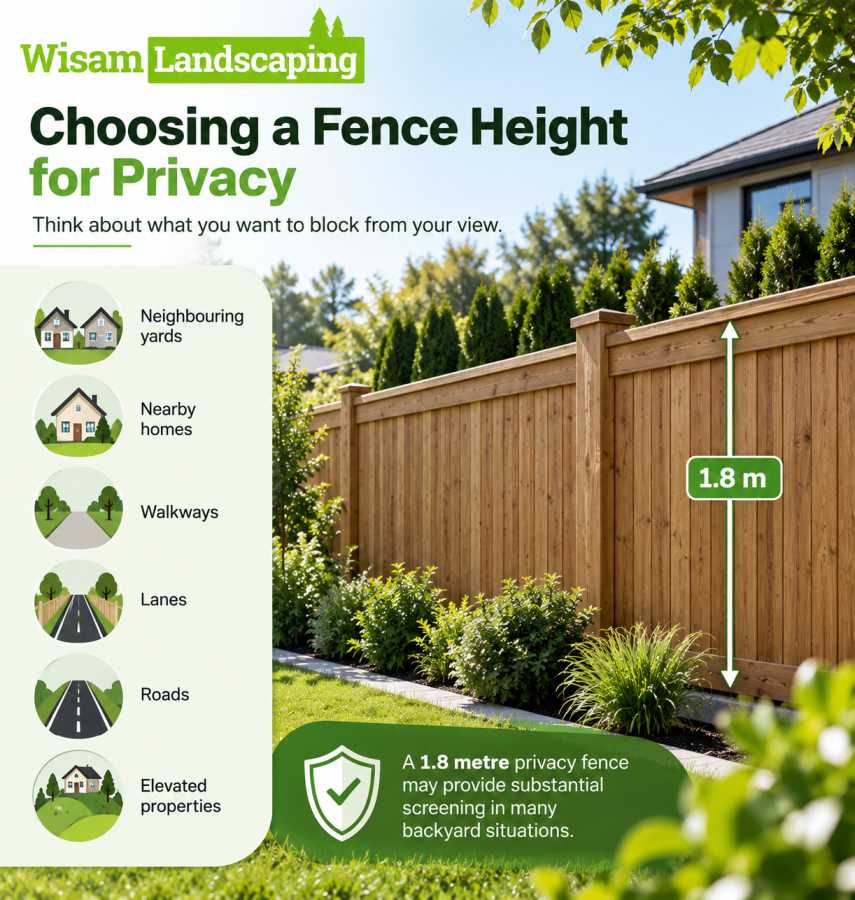
Privacy is often the main reason homeowners install a fence. Think about what you want to block.
You may want to reduce views from:
A 1.8 metre privacy fence may provide substantial screening in many backyard situations.
Front yards need special attention. In Vancouver, required front yards in C-1 and R districts generally have a 1.2 metre fence height limit. The reason is not only appearance.
The City explains that front-yard openness can contribute to the character of the street and allow casual surveillance between homes and public areas. There are circumstances where taller elements may be considered.
For example, the City’s overhead fence bulletin discusses certain pedestrian gates, posts, arbours, and similar features. These may have specific design conditions. So, do not simply build a tall front fence because you want more privacy. Check the applicable rules first.
Backyards usually have different considerations. A taller fence can provide more privacy from neighbouring properties. A 1.8-metre fence is a common reference point in Vancouver residential guidelines for rear and side yards. But the actual permitted height depends on the property and applicable regulations. Think about the slope too.
Side residential fencing can provide separation between properties. They can also help control access to a backyard.
However, side yards can have specific requirements depending on the property. Before starting fence installation in Vancouver, check the zoning information for your address.
The City advises property owners to identify the regulations and policies that apply to their particular property.
Height is only one part of the decision.
The material also affects privacy, appearance, maintenance, and durability.
A wood fence can provide a traditional appearance.
It can be built with solid boards for stronger visual screening.
Wood may require regular maintenance. The required care depends on the wood type, finish, exposure, and local conditions.
Vinyl can provide a clean and uniform appearance.
It is available in several styles.
It can be useful for homeowners who want a low-maintenance option, although the specific product should be selected based on its intended use and installation requirements.
An open fence allows more visibility.
It can help maintain a more open appearance while still defining the property.
However, it provides less privacy than a solid fence.
A solid fence blocks most direct views. This can work great for backyard privacy. A semi-private fence will provide some degree of visibility due to spaces or designs. It makes the garden seem more open.
The selection of the right one depends on what you need. If you require privacy, then a more private fence will suit you better. In case of light and visibility, a semi-private fence would work best.
A fence is only one part of the boundary. The gate also needs to suit the design.
Think about:
A driveway gate has different needs from a small garden gate. Make sure the gate works with the available space. Also check whether the gate design is affected by local requirements.
A very tall solid fence can change how a garden feels. It may reduce direct sunlight in some areas. It can also affect airflow.
Before choosing the maximum possible height, look at the position of the sun and surrounding buildings. You may find that a slightly lower fence combined with plants provides enough privacy.
This can create a softer appearance. Vancouver guidelines also support combining fences with landscaping to create visual depth and screening.
A sloped yard needs careful planning. A fence that measures 1.8 metres at one point may look very different at another point.
Vancouver’s zoning rules state that fence height is measured from the ground level of the site at the fence line. This makes accurate site measurement important.
Do not rely only on a standard fence panel size. The installer should consider the actual ground levels and applicable rules.
Start with your main purpose. For the definition of front gardens, a fence that is not very high could be an ideal choice. Whereas, if you want privacy in your backyard, you might need a fence that is relatively tall.
Whereas, if security is your priority, then the height becomes secondary. Then check the regulations. For a Vancouver property, do not assume that a standard 6-foot fence is automatically permitted.
The current city rules include different limits for front yards and other required yards. Finally, consider the material, maintenance, gate, landscaping, and budget.
Choosing the right fence height requires more than picking a number. Start with your reason for installing the fence. Do you need privacy? Better boundary definition? More controlled access? Or a combination of these?
For many backyard situations, around 1.8 metres can provide useful privacy. But the correct height depends on the property and local rules.
In Vancouver, required front yards in C-1 and R districts generally have a 1.2 metre limit, while other required yards may permit fences up to 1.9 metres, subject to the applicable zoning provisions.
Your property’s zoning, ground levels, retaining walls, and location can affect the answer. Before arranging privacy fence installation in Vancouver, check the property line and current City requirements.
Then choose a material and design that suits your home. For further questions regarding fence installation in Vancouver, you can freely ask Wisam Landscaping.
A height of around 1.8 metres is commonly used for backyard privacy. However, the suitable and permitted height depends on your property, zoning, ground levels, and local requirements.
Under Vancouver’s current zoning rules, a fence in a required yard or on its boundary can generally be up to 1.9 metres. Required front yards in C-1 and R districts are generally limited to 1.2 metres.
A 6-foot fence is approximately 1.8 metres and may be suitable in some rear or side-yard situations. However, you should check the rules that apply to your specific property before installation.
Do not assume so. In required front yards in C-1 and R districts, the general limit is 1.2 metres. Some overheight features may be considered under specific conditions.
You may need a permit to erect a fence or wall in Vancouver. The City recommends checking the requirements for your specific project before construction begins.